What is it?
Nuclear magnetic resonance (NMR) spectroscopy places a sample in a strong magnetic field and probes it with radio waves. Hydrogen nuclei (protons) in different chemical environments absorb at slightly different frequencies, so a ¹H NMR spectrum shows how the hydrogen atoms in a molecule are arranged.
A ¹H NMR spectrum gives four pieces of information:
- Number of signals: how many different hydrogen environments there are.
- Chemical shift, (in ppm): what kind of environment each one is.
- Integration (relative area): how many hydrogens are in each environment.
- Splitting (multiplicity): how many hydrogens are on the neighbouring carbons.
Hydrogens are in the same environment if they are interchangeable by symmetry: the six H atoms in propanone, , are all equivalent, so propanone gives one signal.
Key idea
Each signal is a group of equivalent hydrogens. Its position tells you what is nearby (an oxygen, a C=O, a benzene ring), its area tells you how many H atoms it represents, and its splitting tells you how many H atoms sit on the next carbon along.
Why does it matter?
- Structure determination. NMR is the most powerful tool chemists have for working out how atoms are connected in a new molecule.
- Medicine. MRI (magnetic resonance imaging) is NMR of the hydrogen nuclei in water and fat in the body.
- Industry and research. NMR checks the purity of medicines and follows reactions as they happen.
How does it work?
1. Chemical shift
Shifts are measured relative to a reference, TMS (tetramethylsilane, set at ), and are given in parts per million so that they are the same on every spectrometer:
Nearby electronegative atoms and C=O or aromatic rings pull electron density away from a hydrogen (“deshielding”), moving its signal to a higher δ:
| Type of hydrogen | Typical δ (ppm) |
|---|---|
| alkyl, , | 0.9–1.7 |
| next to C=O, | 2.0–2.7 |
| on carbon next to O, , | 3.3–4.3 |
| alkene, | 4.5–6.5 |
| aromatic, on a benzene ring | 6.5–8.0 |
| aldehyde, | 9–10 |
| carboxylic acid, | 10–12 |
| alcohol | 1–5 (variable) |
2. Integration
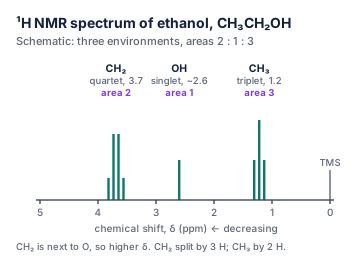
The area under each signal is proportional to the number of hydrogens it represents. Spectrometers print the areas as a ratio, such as 3 : 2 : 1 for ethanol.
3. Splitting: the n + 1 rule
A signal from hydrogens with n equivalent hydrogens on adjacent carbons is split into n + 1 peaks:
| H on neighbouring carbons (n) | 0 | 1 | 2 | 3 |
|---|---|---|---|---|
| Peaks (n + 1) | 1, singlet | 2, doublet | 3, triplet | 4, quartet |
So an ethyl group, , always shows a quartet (the , split by 3 H) and a triplet (the , split by 2 H). An O–H hydrogen usually appears as a singlet and is not split by, nor does it split, its neighbours.
4. ¹³C NMR in brief
¹³C NMR shows one signal for each carbon environment (without splitting in the usual spectra). Typical ranges: alkyl carbons 0–50 ppm, carbons bonded to O 50–90 ppm, alkene and aromatic carbons 110–160 ppm, and C=O carbons 160–220 ppm.
Think of it like this
Reading an NMR spectrum is like working out where people live from a list of neighbours. Each signal is a household; its shift says which part of town it is in (near an oxygen, near a ring); its area says how many people live there; and its splitting says how many people live next door.
More precisely
The n + 1 rule works when the neighbouring hydrogens are all equivalent and couple equally; more complex molecules give multiplets. Adding a drop of makes an O–H or N–H signal disappear, because deuterium replaces the hydrogen and does not show in ¹H NMR; this is a useful way to identify them. Spectrometers are described by their proton frequency (300 MHz, 400 MHz…); a higher frequency spreads the signals out more in Hz, but δ in ppm stays the same.
Visualise it
Worked example
Worked example: Counting environments
Question: How many ¹H NMR signals do these give: (a) propanone, (b) ethanol, (c) methyl ethanoate, ?
- (a) Both groups are equivalent: 1 signal (6H).
- (b) , and : 3 signals (3 : 2 : 1).
- (c) The next to C=O and the on O are different: 2 signals, at about 2.0 and 3.7 ppm, both singlets (no neighbouring H).
Worked example: Chemical shift in ppm
Question: On a 400 MHz spectrometer, a signal appears 1092 Hz from TMS. Calculate δ, and say what kind of hydrogen it might be.
(1 Hz per MHz = 1 ppm.) At 2.73 ppm, it is probably a hydrogen on a carbon next to a C=O group.
Worked example: Predicting a spectrum: ethyl ethanoate
Question: Predict the ¹H NMR spectrum of ethyl ethanoate, .
| Group | δ (ppm) | Area | Neighbours (n) | Splitting |
|---|---|---|---|---|
| about 2.0 | 3 | 0 | singlet | |
| about 4.1 | 2 | 3 | quartet | |
| about 1.3 | 3 | 2 | triplet |
Worked example: Solving a structure
Question: A compound shows a strong IR absorption at 1740 cm⁻¹ (no O–H). Its ¹H NMR spectrum has a triplet at 1.2 ppm (3H), a quartet at 2.3 ppm (2H) and a singlet at 3.7 ppm (3H). Identify it.
- IR: C=O with no O–H, and two O atoms: an ester.
- Triplet (3H) + quartet (2H): an ethyl group. The quartet at 2.3 ppm means the is next to C=O: .
- Singlet at 3.7 ppm (3H): a on oxygen with no neighbours: .
- The compound is methyl propanoate, (4 C, 8 H, 2 O ✓).
Common mistake
Common mistake: Counting the hydrogens on the same carbon
Splitting comes from hydrogens on the neighbouring carbons, not on the same carbon. The in an ethyl group is a triplet because its neighbour, , has 2 H.
Common mistake: Treating integration as an exact count
Integration gives a ratio. If the areas are 1 : 1.5, the actual numbers could be 2 : 3 or 4 : 6. Use the molecular formula to fix the totals.
Common mistake: Expecting O–H to be split
In most spectra the O–H hydrogen appears as a singlet and does not split neighbouring signals, because it exchanges rapidly between molecules.
Notation note
- δ is read “delta”; NMR spectra are drawn with δ decreasing from left to right (like IR).
- s = singlet, d = doublet, t = triplet, q = quartet, m = multiplet.
Remember this
Remember this
- Number of signals = number of H environments. Integration = relative number of H in each.
- δ (ppm) = shift (Hz) ÷ spectrometer frequency (MHz); TMS = 0 ppm.
- Higher δ near electronegative atoms, C=O and rings: about 1 (alkyl), 2–2.7 (next to C=O), 3.3–4.3 (on C–O), 6.5–8 (aromatic), 9–10 (CHO), 10–12 (COOH).
- n + 1 rule: n neighbouring H give n + 1 peaks; ethyl = quartet + triplet.
- Combine MS (mass), IR (functional groups) and NMR (C–H framework) to solve a structure.
Test yourself
Check your understanding before moving on.
Flashcards
NMR Spectroscopy: Flashcards
- QuestionWhat four things does a ¹H NMR spectrum tell you?Answer
Number of H environments (signals), type of environment (δ), number of H in each (integration), and number of neighbouring H (splitting).
- QuestionWhat is TMS used for?Answer
It is the reference compound, set at δ = 0 ppm.
- QuestionHow is chemical shift calculated?Answer
δ (ppm) = shift from TMS (Hz) ÷ spectrometer frequency (MHz).
- QuestionWhy do H atoms near oxygen appear at higher δ?Answer
Electronegative O pulls electron density away (deshielding), shifting the signal to higher δ (about 3.3–4.3 ppm).
- QuestionGive typical δ values for aldehyde, carboxylic acid and aromatic H.Answer
Aldehyde 9–10 ppm; carboxylic acid 10–12 ppm; aromatic 6.5–8.0 ppm.
- QuestionState the n + 1 rule.Answer
A signal from H with n equivalent H on adjacent carbons is split into n + 1 peaks.
- QuestionWhat splitting pattern does an ethyl group give?Answer
A quartet (CH₂, next to 3 H) and a triplet (CH₃, next to 2 H).
- QuestionHow many ¹H NMR signals does propanone give?Answer
One (6 equivalent H), a singlet.
- QuestionHow can you identify an O–H signal?Answer
Add D₂O: the O–H signal disappears. O–H usually appears as a singlet.
- QuestionIn ¹³C NMR, where do C=O carbons appear?Answer
About 160–220 ppm.
Tip: press Space to flip and ← → to move between cards.
Quiz
NMR Spectroscopy: Quiz
7 questions
Three hydrogen environments: CH₃, CH₂ and OH, in a 3 : 2 : 1 ratio.
Show answer
Answer: 3
Three hydrogen environments: CH₃, CH₂ and OH, in a 3 : 2 : 1 ratio.
n + 1 rule: 3 neighbouring H give 3 + 1 = 4 peaks (a quartet).
Show answer
Answer: 4
n + 1 rule: 3 neighbouring H give 3 + 1 = 4 peaks (a quartet).
Aldehyde hydrogens appear at 9–10 ppm. Alkyl H are around 1 ppm, O–CH₃ about 3.3–4.3 ppm, and TMS is 0.
Show answer
Answer: an aldehyde CHO
Aldehyde hydrogens appear at 9–10 ppm. Alkyl H are around 1 ppm, O–CH₃ about 3.3–4.3 ppm, and TMS is 0.
δ = 360 Hz ÷ 300 MHz = 1.20 ppm.
Show answer
Answer: 1.20 ppm
δ = 360 Hz ÷ 300 MHz = 1.20 ppm.
The two CH₃ groups are in different environments (next to C=O and on O). Neither has H on a neighbouring carbon, so both are singlets.
Show answer
Answer: Two singlets (3H each), at about 2.0 and 3.7 ppm
The two CH₃ groups are in different environments (next to C=O and on O). Neither has H on a neighbouring carbon, so both are singlets.
Each CH₃ is next to the CH, which has 1 H: 1 + 1 = 2 peaks. (The CH itself is split by 6 H into a septet.)
Show answer
Answer: Doublet
Each CH₃ is next to the CH, which has 1 H: 1 + 1 = 2 peaks. (The CH itself is split by 6 H into a septet.)
Two equivalent CH₃ (6H, doublet) next to one CH (septet, on C–O at 4.0 ppm), plus an OH singlet: (CH₃)₂CHOH.
Show answer
Answer: Propan-2-ol
Two equivalent CH₃ (6H, doublet) next to one CH (septet, on C–O at 4.0 ppm), plus an OH singlet: (CH₃)₂CHOH.
Notes and downloads
Worksheet
NMR Spectroscopy Worksheet
8 questions on hydrogen environments, chemical shift calculations, splitting, predicting spectra, ¹³C NMR and solving structures from spectra. Answer key included.
References
- Brown, T. L.; LeMay, H. E., Jr.; Bursten, B. E.; Murphy, C. J.; Woodward, P. M.; Stoltzfus, M. W. Chemistry: The Central Science, 15th ed.; Pearson, 2022.
Practise this topic with flashcards and a quiz at chemistryclarity.com/chemistry/nmr-spectroscopy/
Spotted a mistake? Let us know and we'll fix it.