Worksheet
NMR Spectroscopy Worksheet
8 questions on hydrogen environments, chemical shift calculations, splitting, predicting spectra, ¹³C NMR and solving structures from spectra. Answer key included.
- Type
- Worksheet
- Level
- Intermediate
- Format
- PDF, ready to print
Preview the questions
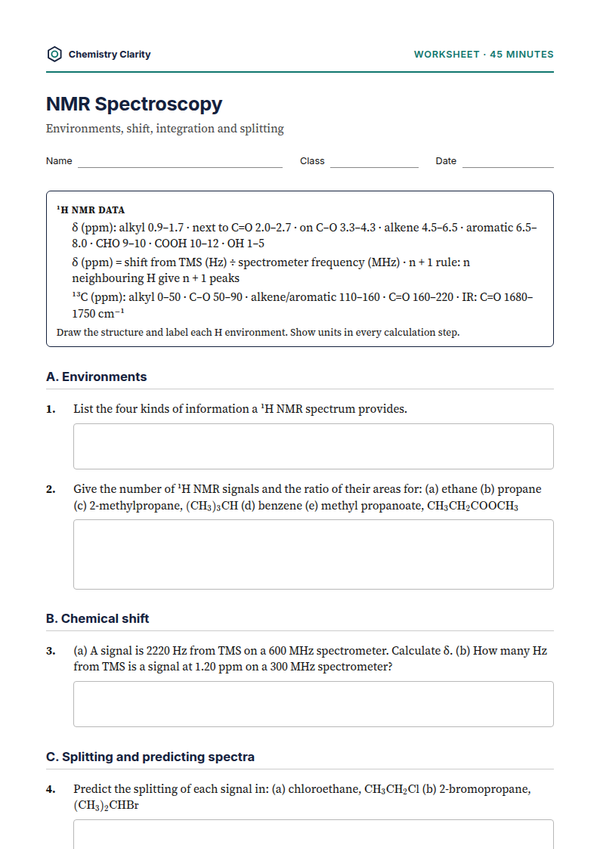
All the questions on this worksheet (about 45 minutes). Download the PDF to print it with space for working; the free answer key has full worked solutions.
A. Environments
1.
List the four kinds of information a ¹H NMR spectrum provides.
2.
Give the number of ¹H NMR signals and the ratio of their areas for: (a) ethane (b) propane (c) 2-methylpropane, (d) benzene (e) methyl propanoate,
B. Chemical shift
3.
(a) A signal is 2220 Hz from TMS on a 600 MHz spectrometer. Calculate δ. (b) How many Hz from TMS is a signal at 1.20 ppm on a 300 MHz spectrometer?
C. Splitting and predicting spectra
4.
Predict the splitting of each signal in: (a) chloroethane, (b) 2-bromopropane,
5.
Predict the full ¹H NMR spectrum (δ, area, splitting) of propanoic acid, .
6.
How many ¹³C NMR signals do these give: (a) propanone (b) ethyl ethanoate (c) benzene?
D. Solving structures
7.
A compound shows: doublet (6H) at 1.2 ppm, septet (1H) at 4.0 ppm, singlet (1H) at 2.2 ppm. Identify it and assign each signal.
E. Challenge
8.
A compound has a strong IR absorption at 1715 cm⁻¹ and a molecular ion at m/z 72. Its ¹H NMR spectrum shows: triplet (3H) at 1.1 ppm, singlet (3H) at 2.1 ppm, quartet (2H) at 2.4 ppm. Identify the compound and explain each piece of evidence.