Worksheet
Ionic and Covalent Bonds Worksheet
9 questions on bond types, electronegativity difference, ionic formulas and properties. Answer key included.
- Type
- Worksheet
- Level
- Beginner
- Format
- PDF, ready to print
Preview the questions
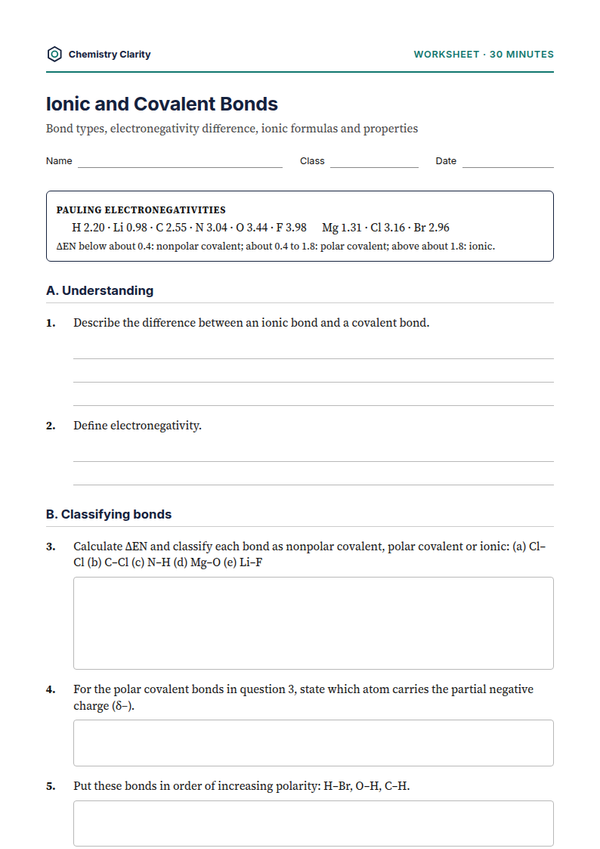
All the questions on this worksheet (about 30 minutes). Download the PDF to print it with space for working; the free answer key has full worked solutions.
A. Understanding
1.
Describe the difference between an ionic bond and a covalent bond.
2.
Define electronegativity.
B. Classifying bonds
3.
Calculate ΔEN and classify each bond as nonpolar covalent, polar covalent or ionic: (a) Cl–Cl (b) C–Cl (c) N–H (d) Mg–O (e) Li–F
4.
For the polar covalent bonds in question 3, state which atom carries the partial negative charge (δ−).
5.
Put these bonds in order of increasing polarity: H–Br, O–H, C–H.
C. Ionic formulas
6.
Write the formulas of the ionic compounds formed between (a) potassium and oxygen (b) calcium and bromine (c) aluminium and nitrogen (d) magnesium and phosphorus.
7.
Write equations showing the formation of the ions when magnesium reacts with chlorine.
D. Properties
8.
Sodium chloride melts at 801 °C, but methane melts at −182 °C. Explain the difference in terms of what must be overcome in each case.
E. Challenge
9.
Solid sodium chloride does not conduct electricity, but molten sodium chloride and sodium chloride solution both do. Explain why.