Worksheet
Intermolecular Forces Worksheet
9 questions on identifying intermolecular forces, explaining boiling points, ice and solubility, and enthalpy of vaporization. Answer key included.
- Type
- Worksheet
- Level
- Intermediate
- Format
- PDF, ready to print
Preview the questions
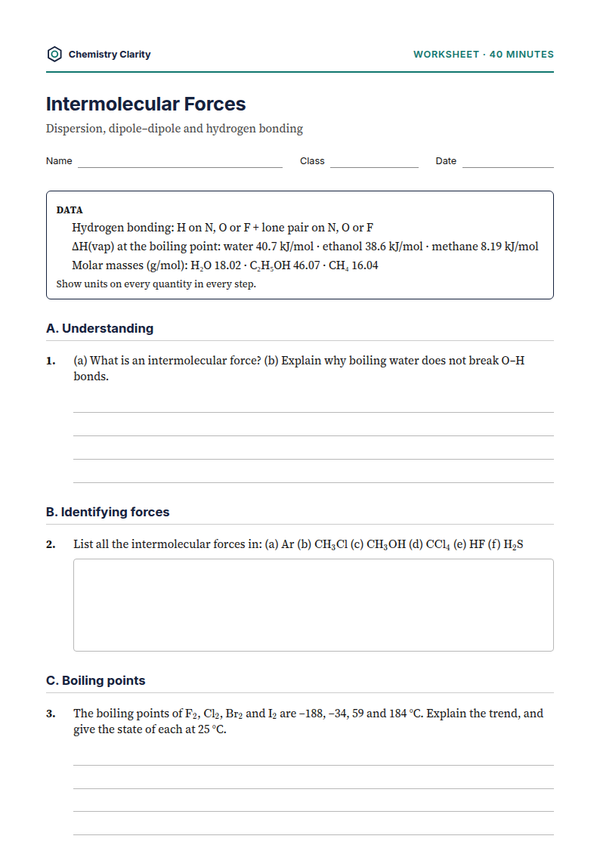
All the questions on this worksheet (about 40 minutes). Download the PDF to print it with space for working; the free answer key has full worked solutions.
A. Understanding
1.
(a) What is an intermolecular force? (b) Explain why boiling water does not break O–H bonds.
B. Identifying forces
2.
List all the intermolecular forces in: (a) Ar (b) (c) (d) (e) HF (f)
C. Boiling points
3.
The boiling points of , , and are −188, −34, 59 and 184 °C. Explain the trend, and give the state of each at 25 °C.
4.
Pentane boils at 36 °C and 2,2-dimethylpropane at 10 °C. Both are . Explain the difference.
5.
For each pair, predict which has the higher boiling point, and explain: (a) ethanol, , or methoxymethane, (b) HCl or HBr (c) or
6.
Explain why ice floats on liquid water.
D. Solubility
7.
Predict whether each dissolves better in water or in hexane, and explain: (a) (b) KCl (c) ethanol (d) octane
E. Calculations
8.
Calculate the energy needed to vaporize (a) 100. g of ethanol (b) 100. g of water, each at its boiling point. (c) Why is the answer to (b) much larger?
9.
Calculate the enthalpy of vaporization per gram of methane and of water. How many times more energy per gram does water need? Explain in terms of intermolecular forces.