What is it?
Percent composition tells you what percentage of a compound’s mass comes from each element.
To work it out, you first need the formula mass: the sum of the atomic masses of all the atoms in the formula, in atomic mass units (u).
Key idea
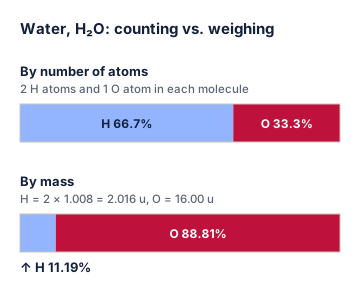
Percent composition is about mass, not about the number of atoms. A light element can make up most of the atoms in a compound but only a small part of its mass.
Why does it matter?
- Identifying substances. Chemists analyse an unknown compound to find the mass of each element it contains. Comparing those percentages with calculated values helps identify the compound, and it is the first step in working out an empirical formula.
- Checking purity. If a sample’s measured composition doesn’t match the expected percentages, it may be impure.
- Everyday labels. Products such as fertilisers state their contents as percentages by mass.
How does it work?
1. Find the formula mass
Add the atomic masses of every atom in the formula, using the subscripts to count atoms. For water, :
A subscript after parentheses multiplies everything inside them. Calcium hydroxide, , contains one Ca, two O and two H:
For molecules this is also called the molecular mass. Ionic compounds like have no molecules, so we say formula mass (the mass of one formula unit).
2. Work out each element’s share
where is the number of atoms of that element in the formula and is its atomic mass.
The percentages of all the elements in a compound add up to 100% (apart from tiny rounding differences).
3. It doesn’t matter how much you have
A pure compound always has the same composition by mass. Every sample of pure water is 11.19% hydrogen by mass, whether it is a drop or a lake. So you can calculate percent composition from the formula alone, using one formula unit or one mole.
Think of it like this
A bag of mixed nuts might contain more peanuts than almonds, but if the almonds are much larger they could still make up most of the bag’s mass. Percent composition works the same way: it weighs each element’s share, it doesn’t count atoms.
More precisely
The atomic masses on the periodic table are weighted averages of the masses of each element’s naturally occurring isotopes. For some elements, IUPAC reports the standard atomic weight as a small range because isotope proportions vary slightly between natural sources. Textbook values such as H = 1.008 are conventional rounded values. They are accurate enough for these calculations.
Visualise it
Worked example
Worked example: Percent composition of glucose
Question: Calculate the percent composition by mass of glucose, . (C = 12.01, H = 1.008, O = 16.00)
- Mass of each element in one formula unit: C: 6 × 12.01 = 72.06 u; H: 12 × 1.008 = 12.096 u; O: 6 × 16.00 = 96.00 u
- Formula mass: 72.06 + 12.096 + 96.00 = 180.156 u
- % C =
- % H =
- % O =
Answer: glucose is 40.00% C, 6.71% H and 53.29% O by mass. Check: 40.00 + 6.71 + 53.29 = 100.00%.
Worked example: Mass of an element in a sample
Question: What mass of iron is contained in 50.0 g of iron(III) oxide, ? (Fe = 55.85, O = 16.00)
- Formula mass: 2(55.85) + 3(16.00) = 111.70 + 48.00 = 159.70 u
- Fraction of the mass that is iron: (that is, 69.94% Fe)
- Mass of iron:
Answer: 50.0 g of contains 35.0 g of iron.
Common mistake
Common mistake: Ignoring subscripts and parentheses
In there are two iron atoms, so iron contributes 2 × 55.85 = 111.70 u, not 55.85 u. Leaving out the 2 gives half the correct mass of iron (17.5 g instead of 35.0 g in the example above).
In , the 2 applies to both O and H: the formula mass is 74.10 u, not 58.10 u.
Common mistake: Counting atoms instead of weighing them
Two-thirds of the atoms in water are hydrogen, but hydrogen is not 66.7% of water. Percent composition is by mass: hydrogen is 11.19% of water’s mass.
Common mistake: Rounding too early
If you round water’s formula mass to 18.02 u before dividing, you get 11.19% H and 88.79% O, which add up to only 99.98%. Keep extra digits (18.016 u) until the final step to get 11.19% and 88.81%.
Notation note
Different textbooks use different names for the same quantity:
- Formula weight and molecular weight are traditional names; formula mass and molecular mass are more common in newer texts. All are given in u (also written amu or Da).
- Some courses use relative formula mass, . It has the same number but no units, because it is measured relative to of the mass of a carbon-12 atom.
- Percent composition is sometimes called mass percent or percentage by mass.
Remember this
Remember this
- Formula mass = sum of the atomic masses of all atoms in the formula (watch subscripts and parentheses).
- % element = (atoms of element × atomic mass) ÷ formula mass × 100%.
- Percent composition is by mass, and it is the same for any sample of a pure compound.
- Keep extra digits until the end; the percentages should add to 100%.
Test yourself
Check your understanding before moving on.
Flashcards
Percent Composition: Flashcards
- QuestionWhat does percent composition tell you?Answer
The percentage of a compound's mass that comes from each element.
- QuestionHow do you calculate the mass percent of an element in a compound?Answer
(number of atoms of the element × atomic mass) ÷ formula mass × 100%
- QuestionWhat is a formula mass?Answer
The sum of the atomic masses of all the atoms in a chemical formula, in u.
- QuestionWhat is the formula mass of ? (Ca = 40.08, O = 16.00, H = 1.008)Answer
u. The 2 multiplies both O and H.
- QuestionWhat is the mass percent of hydrogen in water, ?Answer
- QuestionTwo-thirds of the atoms in water are hydrogen. Why is hydrogen only 11.19% of its mass?Answer
Hydrogen atoms are much lighter than oxygen atoms. Percent composition is by mass, not by number of atoms.
- QuestionDoes the percent composition of a pure compound depend on the size of the sample?Answer
No. A pure compound always has the same composition by mass, so a drop and a lake of pure water have the same percentages.
- QuestionWhat should the mass percents of all elements in a compound add up to?Answer
100%, apart from small rounding differences. Keep extra digits until the end to avoid them.
- QuestionWhat is relative formula mass, ?Answer
The formula mass expressed without units, relative to of the mass of a carbon-12 atom. It has the same number as the formula mass in u.
Tip: press Space to flip and ← → to move between cards.
Quiz
Percent Composition: Quiz
7 questions
The subscript 2 after the parentheses applies to both O and H: u. The answer 58.10 u doubles only the H.
Show answer
Answer: 74.10 u
The subscript 2 after the parentheses applies to both O and H: u. The answer 58.10 u doubles only the H.
. The answer 33.3% is the fraction of atoms that are oxygen (1 of 3), not the fraction of the mass.
Show answer
Answer: 88.81%
. The answer 33.3% is the fraction of atoms that are oxygen (1 of 3), not the fraction of the mass.
Formula mass = 12.01 + 2(16.00) = 44.01 u. % C = . The answer 72.71% is the percentage of oxygen.
Show answer
Answer: 27.29%
Formula mass = 12.01 + 2(16.00) = 44.01 u. % C = . The answer 72.71% is the percentage of oxygen.
Formula mass = 14.01 + 3(1.008) = 17.034 u. % N = . The answer 25.0% counts atoms (1 of 4) instead of mass.
Show answer
Answer: 82.25%
Formula mass = 14.01 + 3(1.008) = 17.034 u. % N = . The answer 25.0% counts atoms (1 of 4) instead of mass.
Formula mass = 2(55.85) + 3(16.00) = 159.70 u. Mass of Fe = g. The answer 17.5 g forgets that there are two Fe atoms in the formula.
Show answer
Answer: 35.0 g
Formula mass = 2(55.85) + 3(16.00) = 159.70 u. Mass of Fe = g. The answer 17.5 g forgets that there are two Fe atoms in the formula.
A pure compound always has the same composition by mass. Both samples are 11.19% hydrogen; only the total mass is different.
Show answer
Answer: They are the same
A pure compound always has the same composition by mass. Both samples are 11.19% hydrogen; only the total mass is different.
Formula mass = 40.08 + 12.01 + 3(16.00) = 100.09 u. % Ca = . The answer 20.0% counts atoms (1 of 5).
Show answer
Answer: 40.04%
Formula mass = 40.08 + 12.01 + 3(16.00) = 100.09 u. % Ca = . The answer 20.0% counts atoms (1 of 5).
References
- Brown, T. L.; LeMay, H. E., Jr.; Bursten, B. E.; Murphy, C. J.; Woodward, P. M.; Stoltzfus, M. W. Chemistry: The Central Science, 15th ed.; Pearson, 2022.
Spotted a mistake? Let us know and we'll fix it.