Worksheet
Classification of Matter Worksheet
9 questions on elements, compounds and mixtures, physical and chemical changes, and separating mixtures. Answer key included.
- Type
- Worksheet
- Level
- Beginner
- Format
- PDF, ready to print
Preview the questions
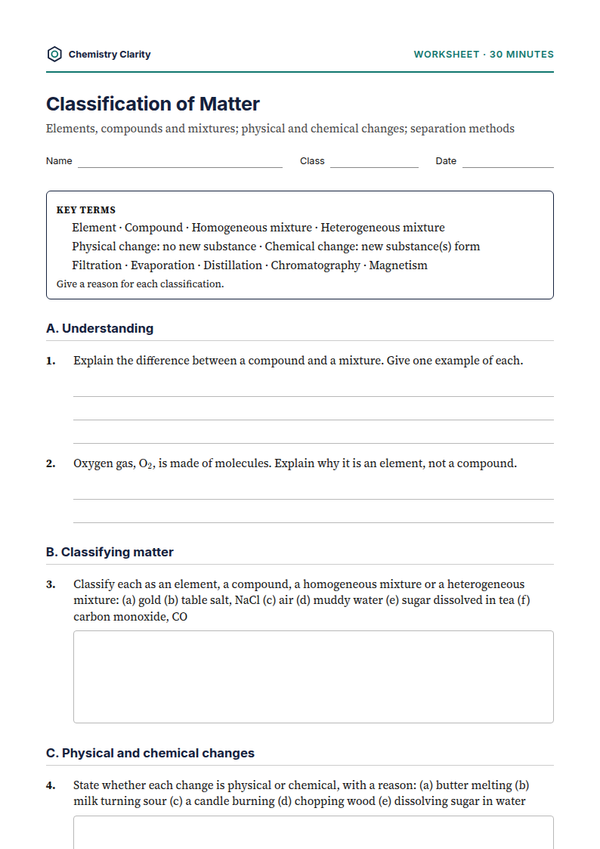
All the questions on this worksheet (about 30 minutes). Download the PDF to print it with space for working; the free answer key has full worked solutions.
A. Understanding
1.
Explain the difference between a compound and a mixture. Give one example of each.
2.
Oxygen gas, , is made of molecules. Explain why it is an element, not a compound.
B. Classifying matter
3.
Classify each as an element, a compound, a homogeneous mixture or a heterogeneous mixture: (a) gold (b) table salt, NaCl (c) air (d) muddy water (e) sugar dissolved in tea (f) carbon monoxide, CO
C. Physical and chemical changes
4.
State whether each change is physical or chemical, with a reason: (a) butter melting (b) milk turning sour (c) a candle burning (d) chopping wood (e) dissolving sugar in water
5.
Classify each property as physical or chemical: (a) the density of copper (b) iron rusts in damp air (c) the boiling point of ethanol (d) hydrogen burns in oxygen
D. Separating mixtures
6.
Choose the best method to separate: (a) sand from water (b) salt from salt water (c) pure water from ink (d) the coloured dyes in a sample of ink (e) iron filings from sulfur powder
7.
A mixture contains sand, salt and water. Describe how you would obtain dry samples of both the sand and the salt.
E. Challenge
8.
Iron and sulfur can form either a mixture or the compound iron(II) sulfide, FeS. Describe two differences between the mixture and the compound.
9.
A sample of water from a river boils at 100.4 °C at 1 atm, while distilled water boils at 100.0 °C. What does this tell you about the river water?