What is it?
An empirical formula shows the simplest whole-number ratio of the atoms in a compound.
A molecular formula shows the actual number of each kind of atom in one molecule.
| Compound | Molecular formula | Empirical formula |
|---|---|---|
| Glucose | ||
| Hydrogen peroxide | ||
| Benzene | ||
| Water | (already the simplest ratio) |
Key idea
The molecular formula is always a whole-number multiple of the empirical formula. Glucose, , is 6 × .
Why does it matter?
When chemists analyse an unknown compound, the experiment does not hand them a formula. It tells them how much of each element is present, usually as a percentage by mass.
Working out the empirical formula turns those measurements into a ratio of atoms. Add a measured molar mass and you get the molecular formula. This is one of the first steps in identifying a new or unknown substance.
How does it work?
From percent composition to empirical formula
- Assume a 100 g sample. Each percentage then becomes a mass in grams (40.00% → 40.00 g).
- Convert grams to moles by dividing by each element’s atomic mass.
- Divide every mole value by the smallest one. This gives the mole ratio.
- Make whole numbers. Values very close to whole numbers (such as 1.99 or 2.01) can be rounded. If a ratio ends in about .5, multiply every value by 2; about .33 or .67, multiply by 3; about .25 or .75, multiply by 4.
- Write the formula using these whole numbers as subscripts.
From empirical formula to molecular formula
You need the compound’s molar mass, which is measured separately. Then:
Multiply every subscript in the empirical formula by (which should be a whole number).
Think of it like this
A recipe that uses 2 cups of flour for every 1 cup of sugar gives the ratio, 2 : 1. That’s like the empirical formula. A baker who uses 6 cups of flour and 3 cups of sugar has the same ratio but a bigger batch. That’s like the molecular formula. To know the batch size you need one more piece of information: for a compound, its molar mass.
More precisely
Experimental percentages carry measurement error, so mole ratios rarely come out as exact whole numbers. A value such as 1.98 is safely rounded to 2, but 1.50 is not “nearly 2”: it signals a ratio of 3 : 2. For compounds containing carbon and hydrogen, the percentages often come from combustion analysis, in which a sample is burned and the masses of and formed are measured.
Visualise it
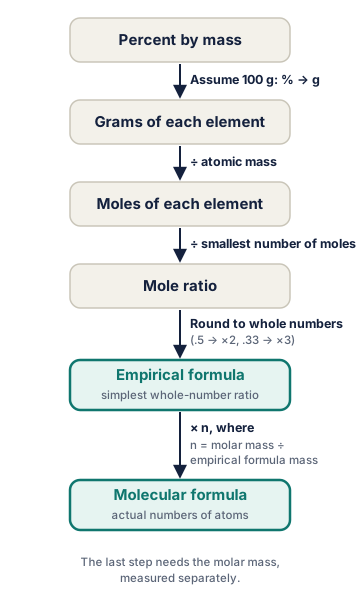
Worked example
Worked example: Empirical and molecular formula of a sugar
Question: A compound is 40.00% C, 6.71% H and 53.29% O by mass. Its molar mass is 180.16 g/mol. Find its empirical and molecular formulas. (C = 12.01, H = 1.008, O = 16.00)
- In 100 g: 40.00 g C, 6.71 g H, 53.29 g O.
- Moles: C: ; H: ; O:
- Divide by the smallest (3.331): C = 1.000, H = 1.999, O = 1.000
- Whole numbers: C : H : O = 1 : 2 : 1, so the empirical formula is .
- Empirical formula mass: 12.01 + 2(1.008) + 16.00 = 30.03 g/mol
- , so multiply every subscript by 6.
Answer: empirical formula ; molecular formula (glucose).
Worked example: When the ratio isn't a whole number
Question: An oxide of iron is 69.94% Fe and 30.06% O by mass. Find its empirical formula. (Fe = 55.85, O = 16.00)
- Moles: Fe: ; O:
- Divide by the smallest: Fe = 1.000, O = 1.500
- 1.500 ends in .5, so multiply both by 2: Fe = 2, O = 3
Answer: the empirical formula is .
Common mistake
Common mistake: Rounding 1.5 up to 2
A ratio of 1 : 1.5 is not “about 1 : 2”. Rounding it would give FeO₂, which is wrong. Multiply every value by 2 instead to get 2 : 3. Only round values that are within a few hundredths of a whole number.
Common mistake: Using the percentages as the ratio
The percentages are a ratio of masses, not of atoms. In the sugar example, 40.00 : 6.71 : 53.29 says nothing directly about the number of atoms. Always convert to moles first.
Common mistake: Dividing by the wrong number
Divide by the smallest number of moles, not the largest. Dividing by the smallest makes the smallest value exactly 1 and the others 1 or more.
Notation note
- The empirical formula is also called the simplest formula.
- Formulas of ionic compounds such as and are empirical formulas, because ionic compounds are not made of separate molecules.
- A molecular formula shows how many atoms there are, but not how they are connected. That is shown by a structural formula.
Remember this
Remember this
- Empirical formula = simplest whole-number ratio; molecular formula = actual numbers of atoms.
- Percent → grams (assume 100 g) → moles → divide by the smallest → whole numbers.
- A ratio ending in .5 means multiply by 2; don’t round it.
- Molecular formula = empirical formula × (molar mass ÷ empirical formula mass).
Test yourself
Check your understanding before moving on.
Flashcards
Empirical Formulas: Flashcards
- QuestionWhat is an empirical formula?Answer
The simplest whole-number ratio of the atoms in a compound.
- QuestionWhat is a molecular formula?Answer
The actual number of each kind of atom in one molecule of a compound.
- QuestionWhat is the empirical formula of glucose, ?Answer
(divide every subscript by 6)
- QuestionWhat is the empirical formula of hydrogen peroxide, ?Answer
- QuestionWhat are the steps from percent composition to an empirical formula?Answer
Assume 100 g (% → g), divide by atomic masses (g → mol), divide by the smallest number of moles, then make whole numbers.
- QuestionYour mole ratio comes out as 1 : 1.50. What should you do?Answer
Multiply both by 2 to get 2 : 3. Never round 1.5 to 2.
- QuestionHow do you get the molecular formula from the empirical formula?Answer
Find = molar mass ÷ empirical formula mass, then multiply every subscript by .
- QuestionA compound has empirical formula and molar mass 42.08 g/mol. What is its molecular formula?Answer
, so .
- QuestionWhy can't you use the percentages directly as the atom ratio?Answer
Percentages compare masses. Atoms of different elements have different masses, so you must convert to moles first.
Tip: press Space to flip and ← → to move between cards.
Quiz
Empirical Formulas: Quiz
7 questions
Divide every subscript by the largest common factor, 6: → . has the right ratio but is not the simplest one.
Show answer
Answer:
Divide every subscript by the largest common factor, 6: → . has the right ratio but is not the simplest one.
In the ratio 1 : 2 cannot be simplified. The others can: → , → , → .
Show answer
Answer:
In the ratio 1 : 2 cannot be simplified. The others can: → , → , → .
A ratio ending in .5 must be multiplied by 2: 1 : 1.50 becomes 2 : 3, so . Rounding 1.5 up to 2 would give the wrong formula, .
Show answer
Answer:
A ratio ending in .5 must be multiplied by 2: 1 : 1.50 becomes 2 : 3, so . Rounding 1.5 up to 2 would give the wrong formula, .
Moles in 100 g: C = 74.87 ÷ 12.01 = 6.234; H = 25.13 ÷ 1.008 = 24.93. Divide by 6.234: C = 1.00, H = 4.00, so . The answer comes from using the percentages directly instead of moles.
Show answer
Answer:
Moles in 100 g: C = 74.87 ÷ 12.01 = 6.234; H = 25.13 ÷ 1.008 = 24.93. Divide by 6.234: C = 1.00, H = 4.00, so . The answer comes from using the percentages directly instead of moles.
Empirical formula mass = 12.01 + 2(1.008) = 14.03 g/mol. , so the molecular formula is .
Show answer
Answer:
Empirical formula mass = 12.01 + 2(1.008) = 14.03 g/mol. , so the molecular formula is .
Empirical formula mass = 12.01 + 1.008 = 13.02 g/mol. , so .
Show answer
Answer:
Empirical formula mass = 12.01 + 1.008 = 13.02 g/mol. , so .
Dividing by the smallest value scales the numbers so the smallest becomes exactly 1. The others then show how many atoms of each element there are for every one atom of that element.
Show answer
Answer: To make the smallest value 1 and find the ratio between elements
Dividing by the smallest value scales the numbers so the smallest becomes exactly 1. The others then show how many atoms of each element there are for every one atom of that element.
References
- Brown, T. L.; LeMay, H. E., Jr.; Bursten, B. E.; Murphy, C. J.; Woodward, P. M.; Stoltzfus, M. W. Chemistry: The Central Science, 15th ed.; Pearson, 2022.
Spotted a mistake? Let us know and we'll fix it.