Worksheet
Oxidation Numbers and Redox Reactions Worksheet
10 questions on oxidation numbers, oxidizing and reducing agents, half-equations, balancing redox equations in acidic and basic solution, and a redox titration. Answer key included.
- Type
- Worksheet
- Level
- Intermediate
- Format
- PDF, ready to print
Preview the questions
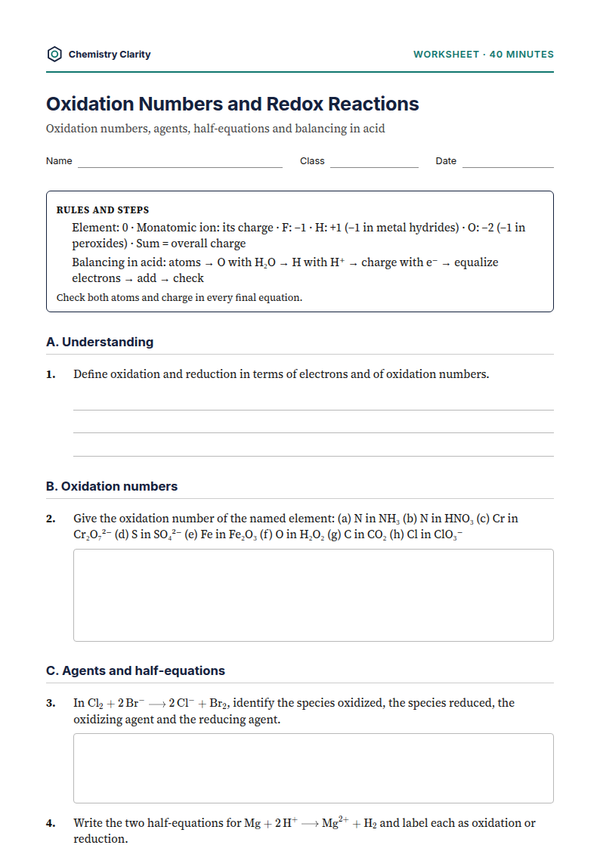
All the questions on this worksheet (about 40 minutes). Download the PDF to print it with space for working; the free answer key has full worked solutions.
A. Understanding
1.
Define oxidation and reduction in terms of electrons and of oxidation numbers.
B. Oxidation numbers
2.
Give the oxidation number of the named element: (a) N in NH₃ (b) N in HNO₃ (c) Cr in Cr₂O₇²⁻ (d) S in SO₄²⁻ (e) Fe in Fe₂O₃ (f) O in H₂O₂ (g) C in CO₂ (h) Cl in ClO₃⁻
C. Agents and half-equations
3.
In , identify the species oxidized, the species reduced, the oxidizing agent and the reducing agent.
4.
Write the two half-equations for and label each as oxidation or reduction.
5.
Which of these are redox reactions? Explain. (a) (b) (c)
D. Balancing
6.
Balance:
7.
Balance in acidic solution:
8.
Balance in acidic solution:
E. Challenge
9.
(a) Balance in acidic solution: . (b) In a titration, 25.00 mL of an solution needs 20.00 mL of 0.0200 M to react completely (). Calculate the concentration of .
10.
Balance in basic solution: