Worksheet
Reaction Rates and Rate Laws Worksheet
9 questions on rates, rate laws, the method of initial rates, units of k and first-order half-life. Answer key included.
- Type
- Worksheet
- Level
- Intermediate
- Format
- PDF, ready to print
Preview the questions
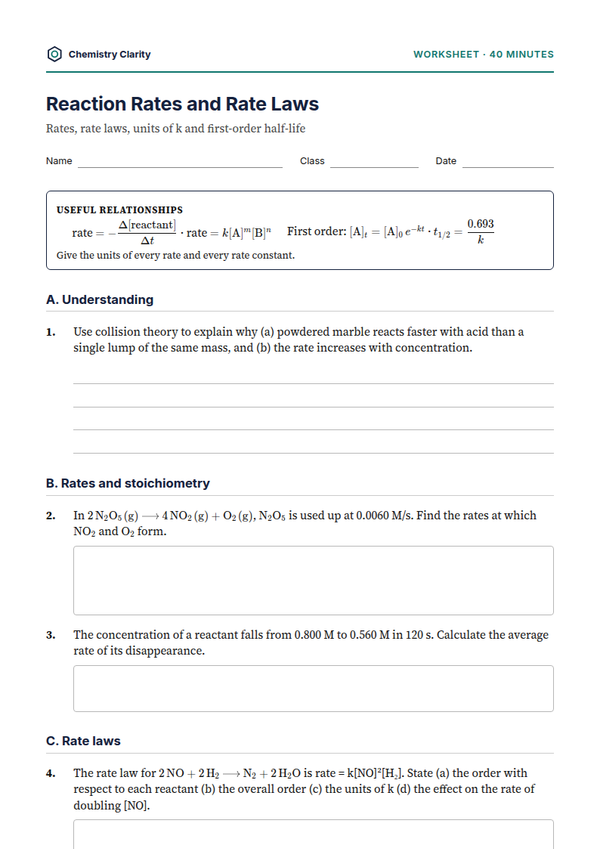
All the questions on this worksheet (about 40 minutes). Download the PDF to print it with space for working; the free answer key has full worked solutions.
A. Understanding
1.
Use collision theory to explain why (a) powdered marble reacts faster with acid than a single lump of the same mass, and (b) the rate increases with concentration.
B. Rates and stoichiometry
2.
In , is used up at 0.0060 M/s. Find the rates at which and form.
3.
The concentration of a reactant falls from 0.800 M to 0.560 M in 120 s. Calculate the average rate of its disappearance.
C. Rate laws
4.
The rate law for is rate = k[NO]²[H₂]. State (a) the order with respect to each reactant (b) the overall order (c) the units of k (d) the effect on the rate of doubling [NO].
5.
For : Experiment 1: [NO] = 0.020 M, [O₂] = 0.010 M, rate = 2.8 × 10⁻⁶ M/s. Experiment 2: [NO] = 0.040 M, [O₂] = 0.010 M, rate = 1.12 × 10⁻⁵ M/s. Experiment 3: [NO] = 0.020 M, [O₂] = 0.020 M, rate = 5.6 × 10⁻⁶ M/s. Determine the rate law and the value and units of k.
6.
Using your rate law from question 5, what happens to the rate if [NO] is doubled and [O₂] is halved at the same time?
7.
Give the units of k for a zero-order, a first-order and a second-order reaction (concentrations in M, time in s).
D. Half-life
8.
A first-order reaction has . (a) Find its half-life. (b) If M, what is [A] after 900. s?
E. Challenge
9.
A first-order reaction has and M. Calculate (a) [A] after 60.0 min and (b) the time for [A] to fall to 0.0500 M.