Worksheet
Radioactive Decay and Half-Life Worksheet
9 questions on nuclide notation, nuclear equations, types of radiation, half-life calculations and radiocarbon dating. Answer key included.
- Type
- Worksheet
- Level
- Intermediate
- Format
- PDF, ready to print
Preview the questions
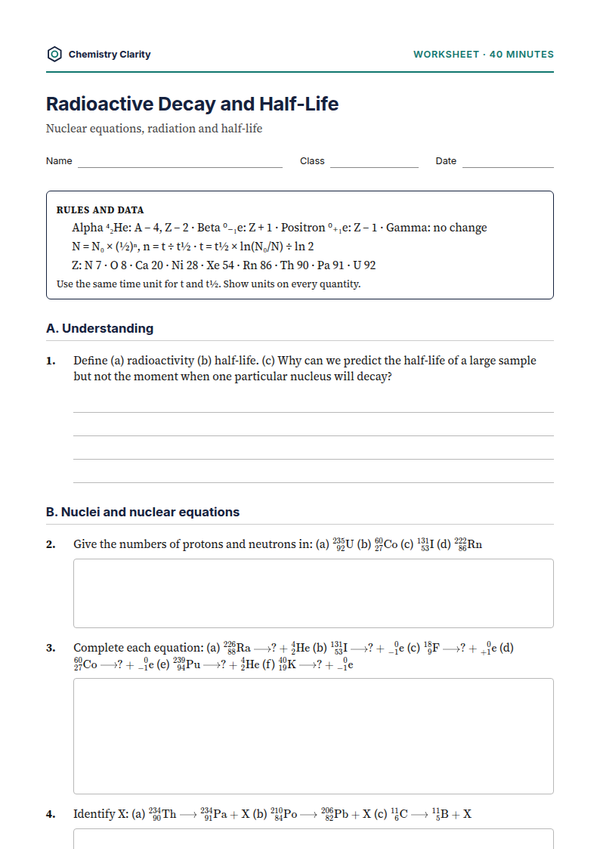
All the questions on this worksheet (about 40 minutes). Download the PDF to print it with space for working; the free answer key has full worked solutions.
A. Understanding
1.
Define (a) radioactivity (b) half-life. (c) Why can we predict the half-life of a large sample but not the moment when one particular nucleus will decay?
B. Nuclei and nuclear equations
2.
Give the numbers of protons and neutrons in: (a) (b) (c) (d)
3.
Complete each equation: (a) (b) (c) (d) (e) (f)
4.
Identify X: (a) (b) (c)
5.
Uranium-238 () decays by alpha emission, then beta, then beta again. Write the three equations and identify the final nucleus.
C. Types of radiation
6.
Compare alpha, beta and gamma radiation: what each one is, its charge, and what stops it. Explain why an alpha emitter is most dangerous inside the body.
D. Half-life
7.
A patient is given technetium-99m with an activity of 800 MBq ( = 6.01 h). What is its activity after 24.04 h?
8.
(a) The activity of a sample falls from 1600 Bq to 400 Bq in 30.0 min. Find its half-life. (b) Radon-222 has = 3.82 d. What percentage of a sample remains after 10.0 d?
E. Challenge
9.
A sample of carbon from an ancient wooden bowl has a carbon-14 activity of 0.0850 Bq per gram of carbon. Carbon from fresh wood measured in the same laboratory gives 0.230 Bq per gram. Estimate the age of the bowl ( of carbon-14 = 5730 yr).