Worksheet
Le Chatelier's Principle Worksheet
9 questions on how concentration, pressure, temperature and catalysts affect equilibria, including Q calculations. Answer key included.
- Type
- Worksheet
- Level
- Intermediate
- Format
- PDF, ready to print
Preview the questions
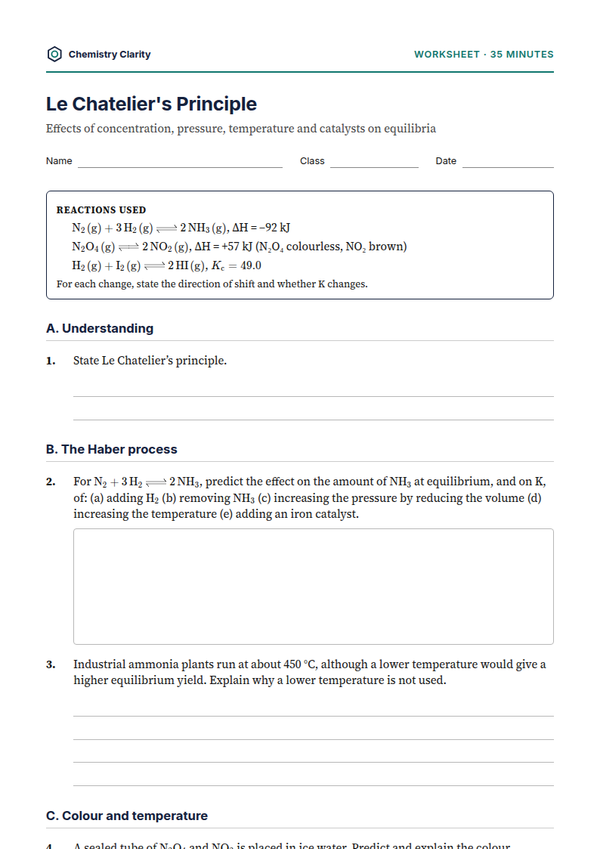
All the questions on this worksheet (about 35 minutes). Download the PDF to print it with space for working; the free answer key has full worked solutions.
A. Understanding
1.
State Le Chatelier’s principle.
B. The Haber process
2.
For , predict the effect on the amount of at equilibrium, and on K, of: (a) adding (b) removing (c) increasing the pressure by reducing the volume (d) increasing the temperature (e) adding an iron catalyst.
3.
Industrial ammonia plants run at about 450 °C, although a lower temperature would give a higher equilibrium yield. Explain why a lower temperature is not used.
C. Colour and temperature
4.
A sealed tube of and is placed in ice water. Predict and explain the colour change.
5.
The same tube is quickly compressed to half its volume at constant temperature. The colour first darkens, then becomes slightly paler (but stays darker than at the start). Explain both observations.
D. Special cases
6.
Explain why changing the pressure does not shift .
7.
More solid is added to at equilibrium. What happens? Explain.
E. Using Q
8.
An equilibrium mixture of contains 0.0222 M , 0.0222 M and 0.156 M HI. 0.100 M is added. Calculate Q immediately after the addition and predict the direction of shift.
F. Challenge
9.
For the change in question 8, calculate the new equilibrium concentrations. (Let be the decrease in ; you will need to solve a quadratic equation. Use the unrounded starting values 0.02222 M, 0.12222 M and 0.15556 M.)