Worksheet
Entropy and Gibbs Free Energy Worksheet
9 questions on predicting ΔS, calculating ΔS° and ΔG°, switching temperatures, ΔG° and K, and the link to cell voltage. Answer key included.
- Type
- Worksheet
- Level
- Advanced
- Format
- PDF, ready to print
Preview the questions
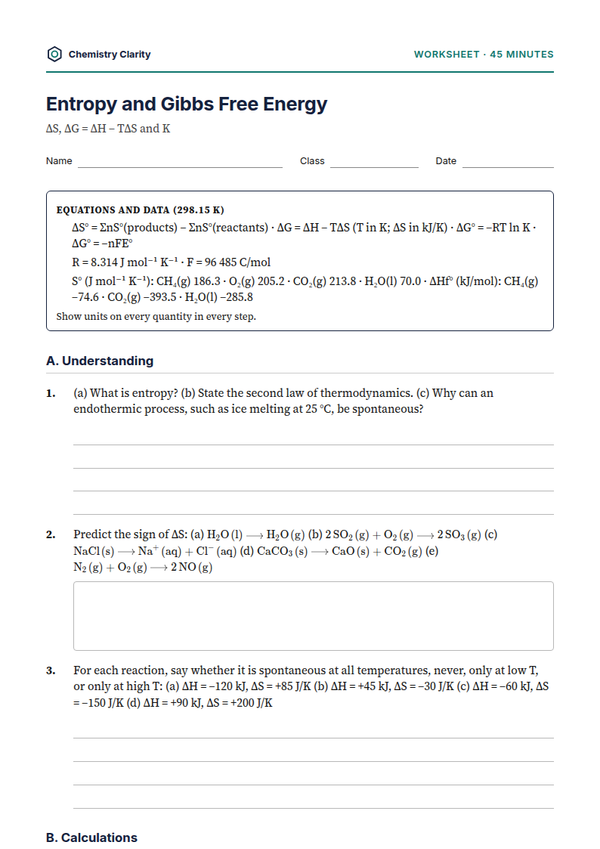
All the questions on this worksheet (about 45 minutes). Download the PDF to print it with space for working; the free answer key has full worked solutions.
A. Understanding
1.
(a) What is entropy? (b) State the second law of thermodynamics. (c) Why can an endothermic process, such as ice melting at 25 °C, be spontaneous?
2.
Predict the sign of ΔS: (a) (b) (c) (d) (e)
3.
For each reaction, say whether it is spontaneous at all temperatures, never, only at low T, or only at high T: (a) ΔH = −120 kJ, ΔS = +85 J/K (b) ΔH = +45 kJ, ΔS = −30 J/K (c) ΔH = −60 kJ, ΔS = −150 J/K (d) ΔH = +90 kJ, ΔS = +200 J/K
B. Calculations
4.
Calculate ΔS° for and explain its sign.
5.
Calculate ΔH° and ΔG° at 298.15 K for the same reaction.
6.
For melting ice, ΔH = +6.01 kJ/mol and ΔS = +22.0 J mol⁻¹ K⁻¹. (a) At what temperature is ΔG = 0? (b) Find ΔG at −10.0 °C and at +10.0 °C, and explain what each result means.
7.
For , ΔH° = +179.2 kJ and ΔS° = +160.2 J/K. Calculate ΔG° at 1200 K. Is the decomposition spontaneous?
8.
A reaction has ΔG° = +10.0 kJ at 298.15 K. Calculate K, and say whether reactants or products are favoured.
C. Challenge
9.
The Daniell cell has E° = 1.10 V and n = 2. Calculate (a) ΔG° (b) K at 298.15 K. What does the size of K tell you?