Worksheet
Gas Laws Worksheet
9 questions on Boyle's, Charles's and Gay-Lussac's laws, the combined gas law and PV = nRT. Answer key included.
- Type
- Worksheet
- Level
- Intermediate
- Format
- PDF, ready to print
Preview the questions
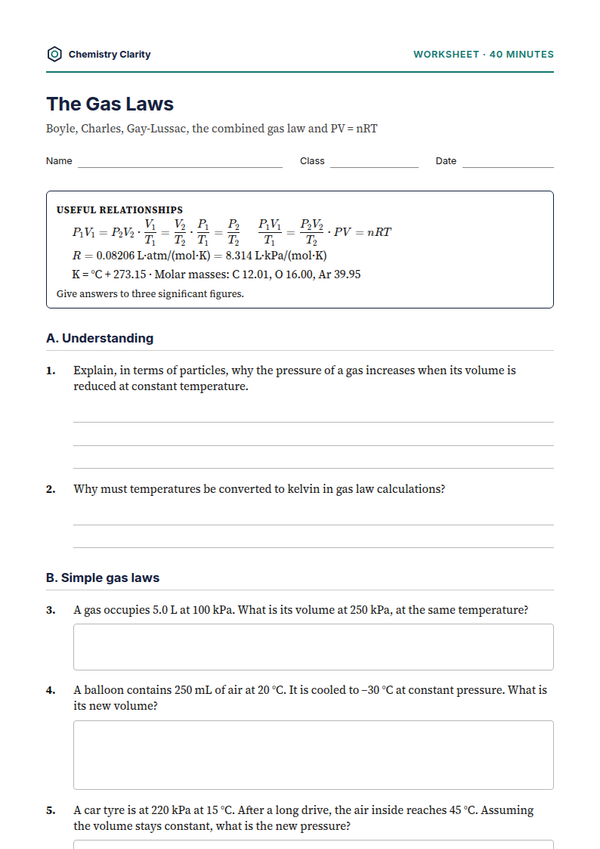
All the questions on this worksheet (about 40 minutes). Download the PDF to print it with space for working; the free answer key has full worked solutions.
A. Understanding
1.
Explain, in terms of particles, why the pressure of a gas increases when its volume is reduced at constant temperature.
2.
Why must temperatures be converted to kelvin in gas law calculations?
B. Simple gas laws
3.
A gas occupies 5.0 L at 100 kPa. What is its volume at 250 kPa, at the same temperature?
4.
A balloon contains 250 mL of air at 20 °C. It is cooled to −30 °C at constant pressure. What is its new volume?
5.
A car tyre is at 220 kPa at 15 °C. After a long drive, the air inside reaches 45 °C. Assuming the volume stays constant, what is the new pressure?
C. Combined gas law
6.
A 4.00 L sample of gas at 1.00 atm and 25 °C is changed to 2.50 atm and 100 °C. What is its new volume?
D. Ideal gas law
7.
Calculate the pressure, in atm, of 0.250 mol of gas in a 5.00 L container at 300 K.
8.
A 2.00 L flask contains carbon dioxide at 1.50 atm and 27 °C. Calculate (a) the number of moles of and (b) its mass.
E. Challenge
9.
A 1.00 g sample of a gas occupies 0.560 L at 1.00 atm and 0 °C. Calculate its molar mass and suggest which noble gas it is.