Worksheet
Electrolysis Worksheet
9 questions on electrode products, half-equations, industrial electrolysis, and Faraday's-law mass, time, gas-volume and energy calculations. Answer key included.
- Type
- Worksheet
- Level
- Intermediate
- Format
- PDF, ready to print
Preview the questions
All the questions on this worksheet (about 45 minutes). Download the PDF to print it with space for working; the free answer key has full worked solutions.
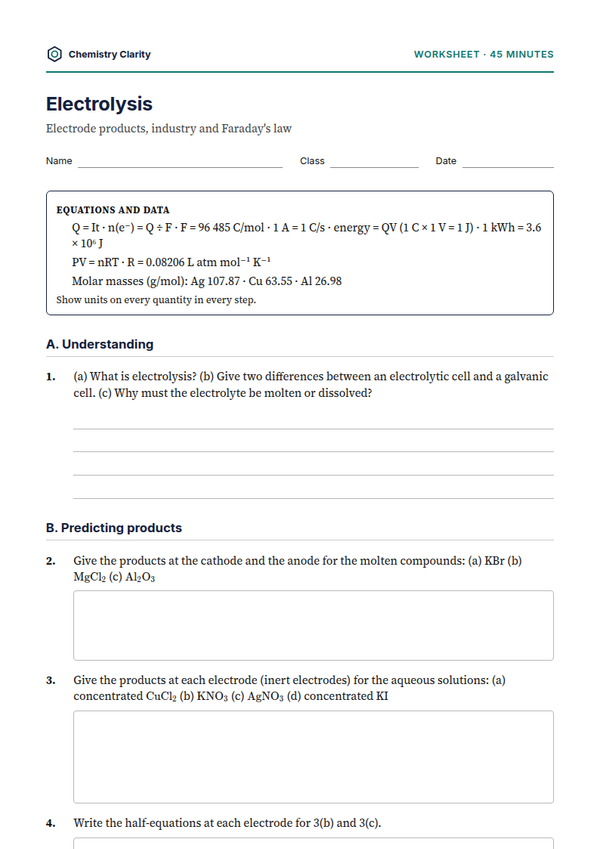
A. Understanding
1.
(a) What is electrolysis? (b) Give two differences between an electrolytic cell and a galvanic cell. (c) Why must the electrolyte be molten or dissolved?
B. Predicting products
2.
Give the products at the cathode and the anode for the molten compounds: (a) KBr (b) (c)
3.
Give the products at each electrode (inert electrodes) for the aqueous solutions: (a) concentrated (b) (c) (d) concentrated KI
4.
Write the half-equations at each electrode for 3(b) and 3(c).
5.
In copper refining, explain what happens at the anode and at the cathode, and what happens to the impurities.
C. Faraday’s law
6.
A spoon is silver-plated with a current of 0.500 A for 30.0 min. What mass of silver is deposited? ()
7.
How long (in minutes) must a current of 1.50 A flow to deposit 2.00 g of copper from ?
8.
Dilute sulfuric acid is electrolysed with 0.500 A for 2.00 h. Calculate the volumes of hydrogen and oxygen produced at 25.0 °C and 1.00 atm.
D. Challenge
9.
An aluminium cell runs at 4.5 V. (a) What charge is needed to make 1.00 kg of aluminium? (b) How much electrical energy is this, in J and in kWh? (c) Suggest why aluminium smelters are often built near cheap hydroelectric power.