Worksheet
Activation Energy and Catalysts Worksheet
9 questions on activation energy, energy profiles, the Maxwell–Boltzmann distribution, the Arrhenius equation and catalysts. Answer key included.
- Type
- Worksheet
- Level
- Intermediate
- Format
- PDF, ready to print
Preview the questions
All the questions on this worksheet (about 40 minutes). Download the PDF to print it with space for working; the free answer key has full worked solutions.
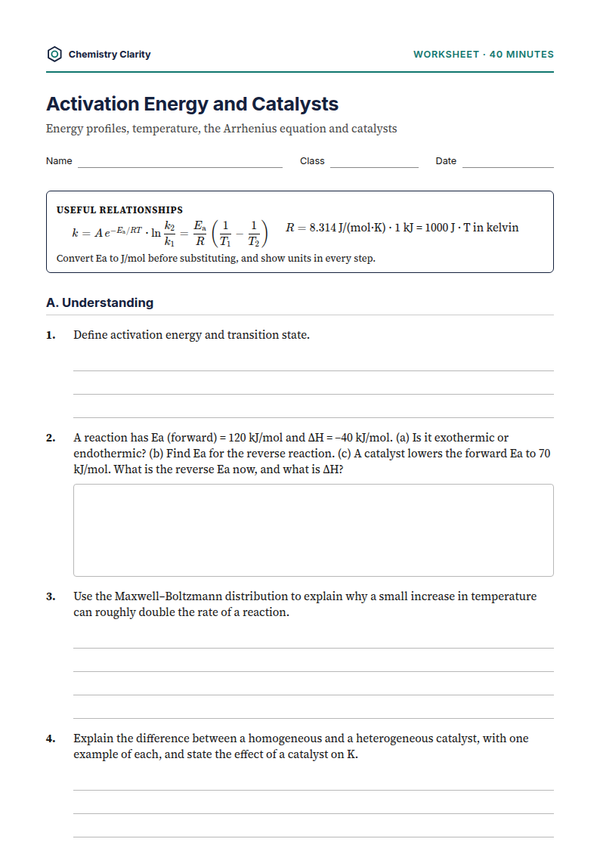
A. Understanding
1.
Define activation energy and transition state.
2.
A reaction has Ea (forward) = 120 kJ/mol and ΔH = −40 kJ/mol. (a) Is it exothermic or endothermic? (b) Find Ea for the reverse reaction. (c) A catalyst lowers the forward Ea to 70 kJ/mol. What is the reverse Ea now, and what is ΔH?
3.
Use the Maxwell–Boltzmann distribution to explain why a small increase in temperature can roughly double the rate of a reaction.
4.
Explain the difference between a homogeneous and a heterogeneous catalyst, with one example of each, and state the effect of a catalyst on K.
B. The Arrhenius equation
5.
A reaction has Ea = 75.0 kJ/mol. By what factor does k increase between 300. K and 310. K?
6.
A rate constant is at 500. K and at 550. K. Calculate Ea in kJ/mol.
7.
For a reaction with Ea = 75.0 kJ/mol, at 300. K. Calculate k at 330. K.
C. Challenge
8.
A catalyst lowers Ea from 75.0 kJ/mol to 50.0 kJ/mol at 298 K. Assuming the frequency factor A is unchanged, by what factor does the rate constant increase?
9.
An Arrhenius plot of ln k against 1/T is a straight line with slope K. Calculate Ea.