Worksheet
Lewis Structures Worksheet
9 questions on counting valence electrons, drawing Lewis structures, formal charge and resonance. Answer key included.
- Type
- Worksheet
- Level
- Intermediate
- Format
- PDF, ready to print
Preview the questions
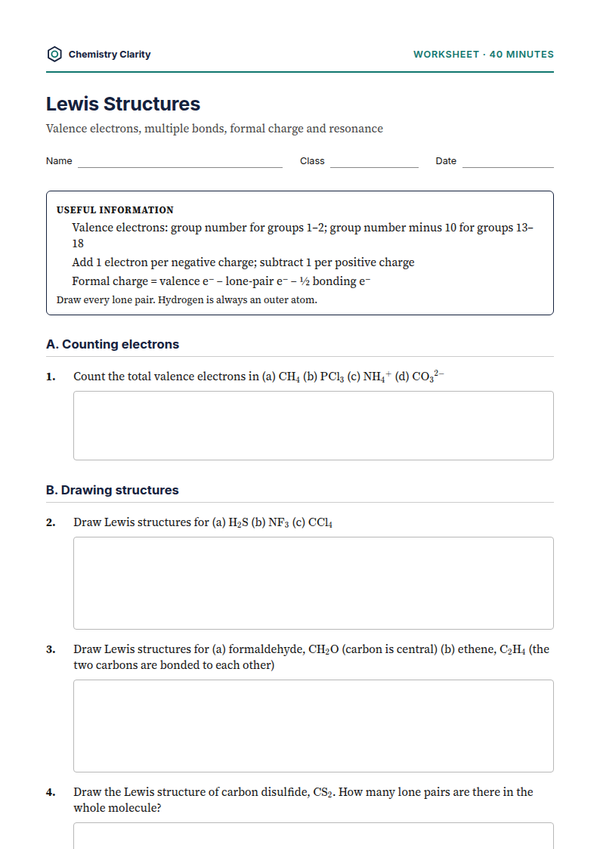
All the questions on this worksheet (about 40 minutes). Download the PDF to print it with space for working; the free answer key has full worked solutions.
A. Counting electrons
1.
Count the total valence electrons in (a) (b) (c) (d)
B. Drawing structures
2.
Draw Lewis structures for (a) (b) (c)
3.
Draw Lewis structures for (a) formaldehyde, (carbon is central) (b) ethene, (the two carbons are bonded to each other)
4.
Draw the Lewis structure of carbon disulfide, . How many lone pairs are there in the whole molecule?
5.
Draw the Lewis structure of the ammonium ion, , and calculate the formal charge on nitrogen.
C. Formal charge and resonance
6.
Ozone, , has 18 valence electrons. Draw one Lewis structure and calculate the formal charge on each oxygen atom.
7.
Draw the resonance structures of the nitrate ion, . What does resonance tell you about the three N–O bond lengths?
D. Exceptions
8.
Explain why is an exception to the octet rule. How many electrons surround boron?
E. Challenge
9.
Xenon tetrafluoride, , has 36 valence electrons. Draw its Lewis structure. How many electrons surround xenon, and why is this possible?