Worksheet
Hess's Law and Enthalpies of Formation Worksheet
9 questions on Hess's law, combining thermochemical equations and calculating ΔH from enthalpies of formation. Answer key included.
- Type
- Worksheet
- Level
- Intermediate
- Format
- PDF, ready to print
Preview the questions
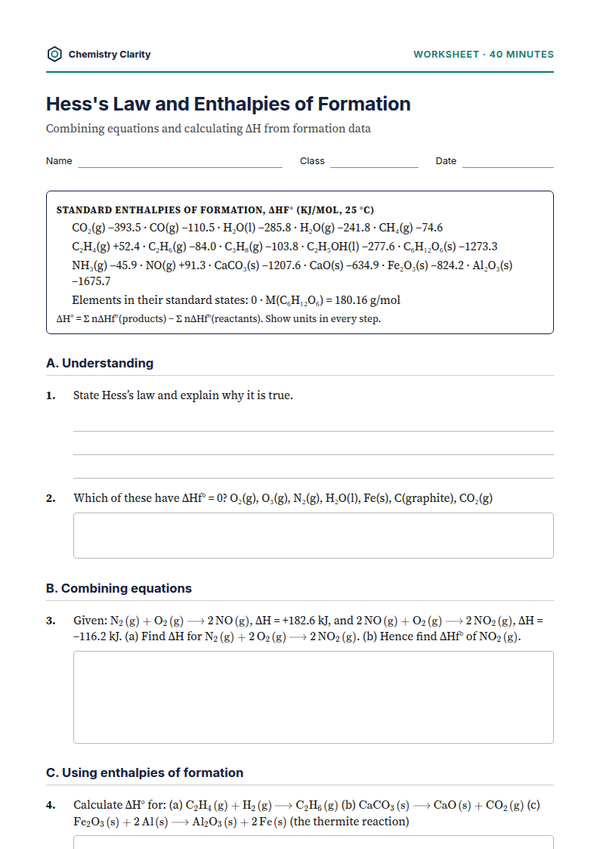
All the questions on this worksheet (about 40 minutes). Download the PDF to print it with space for working; the free answer key has full worked solutions.
A. Understanding
1.
State Hess’s law and explain why it is true.
2.
Which of these have ΔHf° = 0? O₂(g), O₃(g), N₂(g), H₂O(l), Fe(s), C(graphite), CO₂(g)
B. Combining equations
3.
Given: , ΔH = +182.6 kJ, and , ΔH = −116.2 kJ. (a) Find ΔH for . (b) Hence find ΔHf° of .
C. Using enthalpies of formation
4.
Calculate ΔH° for: (a) (b) (c) (the thermite reaction)
5.
Calculate ΔH° for the combustion of propane:
6.
Calculate ΔH° for , the first step in making nitric acid.
7.
Use the table to find ΔH° for . What does this value represent?
D. Challenge
8.
The combustion of ethanol, , has ΔH° = −1366.8 kJ. Use this and the table (ignoring the ethanol value) to calculate ΔHf° of ethanol.
9.
Calculate ΔH° for the combustion of glucose, , and the energy released when 10.0 g of glucose is oxidized in the body.