Worksheet
Nuclear Fission and Fusion Worksheet
9 questions on mass defect, binding energy, E = mc², nuclear equations, reactors, and energy from fission, fusion and the Sun. Answer key included.
- Type
- Worksheet
- Level
- Intermediate
- Format
- PDF, ready to print
Preview the questions
All the questions on this worksheet (about 40 minutes). Download the PDF to print it with space for working; the free answer key has full worked solutions.
A. Understanding
1.
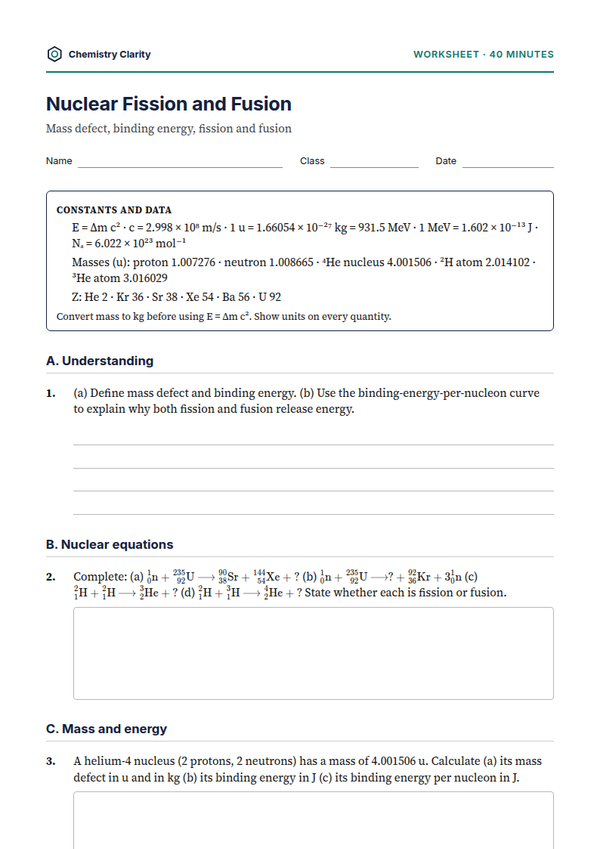
(a) Define mass defect and binding energy. (b) Use the binding-energy-per-nucleon curve to explain why both fission and fusion release energy.
B. Nuclear equations
2.
Complete: (a) (b) (c) (d) State whether each is fission or fusion.
C. Mass and energy
3.
A helium-4 nucleus (2 protons, 2 neutrons) has a mass of 4.001506 u. Calculate (a) its mass defect in u and in kg (b) its binding energy in J (c) its binding energy per nucleon in J.
4.
How much energy would be released if 1.00 g of matter were converted completely into energy?
D. Fission and reactors
5.
Explain the job of (a) the moderator (b) the control rods (c) the coolant in a nuclear reactor. (d) What is meant by critical mass?
6.
Give two differences between fission and fusion, and explain why fusion needs temperatures of millions of degrees.
7.
Each fission of uranium-235 releases about 200 MeV. Calculate the energy released (a) per fission, in J (b) per mole of uranium-235 (c) per gram of uranium-235 (235.04 g/mol). (d) Burning methane releases 890 kJ/mol (16.04 g/mol). About how many times more energy per gram does fission release?
E. Fusion and the Sun
8.
Calculate the energy, in MeV, released by , using atomic masses from the data box.
9.
The Sun radiates 3.83 × 10²⁶ J every second. (a) How much mass does it convert into energy each second? (b) The Sun’s mass is 1.989 × 10³⁰ kg. At this rate, how many years would it take to lose 1.00 % of its mass? (1 yr = 3.156 × 10⁷ s)