Worksheet
Electron Configuration Worksheet
9 questions on configurations of atoms and ions, orbital diagrams and unpaired electrons. Answer key included.
- Type
- Worksheet
- Level
- Intermediate
- Format
- PDF, ready to print
Preview the questions
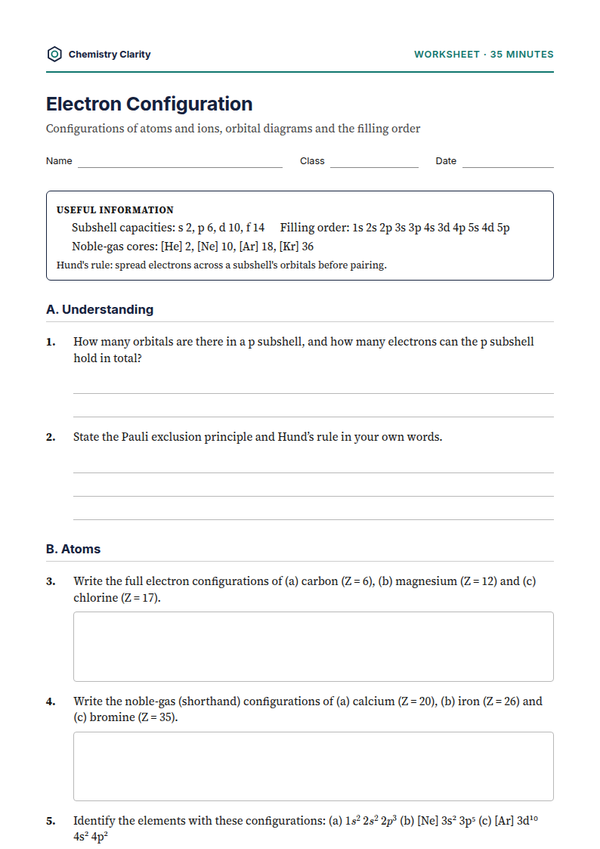
All the questions on this worksheet (about 35 minutes). Download the PDF to print it with space for working; the free answer key has full worked solutions.
A. Understanding
1.
How many orbitals are there in a p subshell, and how many electrons can the p subshell hold in total?
2.
State the Pauli exclusion principle and Hund’s rule in your own words.
B. Atoms
3.
Write the full electron configurations of (a) carbon (Z = 6), (b) magnesium (Z = 12) and (c) chlorine (Z = 17).
4.
Write the noble-gas (shorthand) configurations of (a) calcium (Z = 20), (b) iron (Z = 26) and (c) bromine (Z = 35).
5.
Identify the elements with these configurations: (a) (b) [Ne] 3s² 3p⁵ (c) [Ar] 3d¹⁰ 4s² 4p²
C. Orbital diagrams
6.
Draw the orbital diagram (boxes and arrows) for the 2s and 2p subshells of nitrogen. How many unpaired electrons does nitrogen have?
7.
How many unpaired electrons are there in (a) a sulfur atom and (b) a neon atom?
D. Ions
8.
Write the configurations of (a) (b) (c) . Which two of these ions have the same configuration?
E. Challenge
9.
The configuration of chromium (Z = 24) is [Ar] 3d⁵ 4s¹, not [Ar] 3d⁴ 4s². Suggest why, and state how many unpaired electrons a chromium atom has.