Worksheet
Solubility and Colligative Properties Worksheet
9 questions on solubility, molality, freezing-point depression, boiling-point elevation, osmotic pressure and molar mass. Answer key included.
- Type
- Worksheet
- Level
- Intermediate
- Format
- PDF, ready to print
Preview the questions
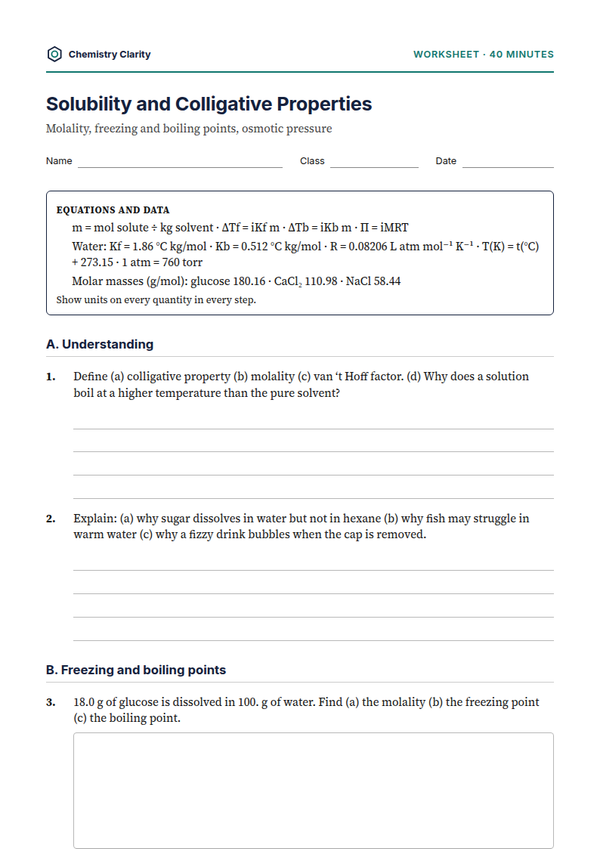
All the questions on this worksheet (about 40 minutes). Download the PDF to print it with space for working; the free answer key has full worked solutions.
A. Understanding
1.
Define (a) colligative property (b) molality (c) van ‘t Hoff factor. (d) Why does a solution boil at a higher temperature than the pure solvent?
2.
Explain: (a) why sugar dissolves in water but not in hexane (b) why fish may struggle in warm water (c) why a fizzy drink bubbles when the cap is removed.
B. Freezing and boiling points
3.
18.0 g of glucose is dissolved in 100. g of water. Find (a) the molality (b) the freezing point (c) the boiling point.
4.
Put these 0.10 mol/kg aqueous solutions in order of freezing point, highest first: , glucose, NaCl. Explain.
5.
11.1 g of is dissolved in 250. g of water. Find the freezing point ( = 3).
6.
3.00 g of a molecular compound dissolved in 50.0 g of water raises the boiling point by 0.256 °C. Find its molar mass.
C. Osmotic pressure
7.
1.00 g of a protein is dissolved in water to make 100.0 mL of solution. Its osmotic pressure at 25.0 °C is 3.80 torr. Find the molar mass of the protein.
8.
Blood has an osmotic pressure of about 7.70 atm at 37.0 °C. What concentration of NaCl ( = 2) would have the same osmotic pressure?
D. Challenge
9.
What mass of NaCl must be dissolved in 1.00 kg of water to lower its freezing point to −10.0 °C ( = 2)? Suggest why calcium chloride is often used instead in very cold places.