Worksheet
Chromatography Worksheet
9 questions on phases, Rf values, TLC technique, polarity, gas chromatography, replicate measurements and peak-area calculations. Answer key included.
- Type
- Worksheet
- Level
- Intermediate
- Format
- PDF, ready to print
Preview the questions
All the questions on this worksheet (about 40 minutes). Download the PDF to print it with space for working; the free answer key has full worked solutions.
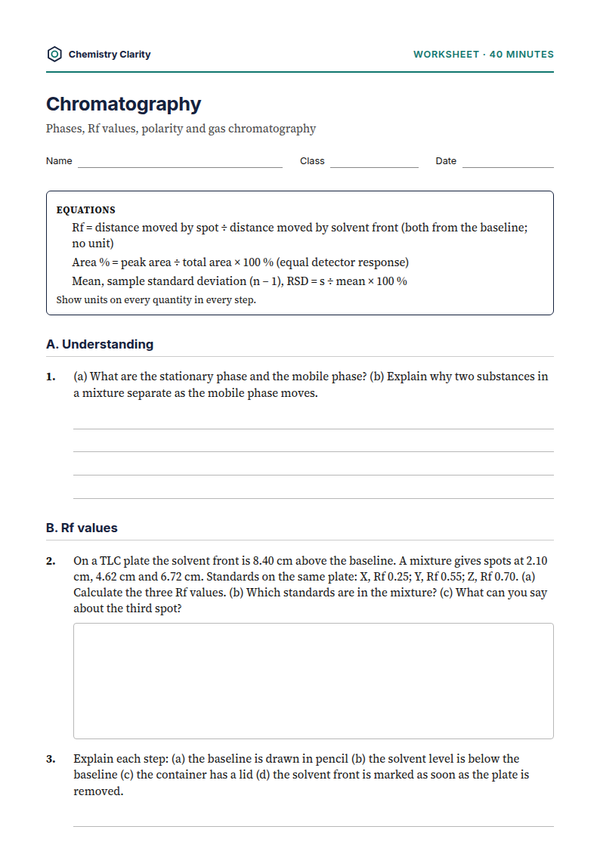
A. Understanding
1.
(a) What are the stationary phase and the mobile phase? (b) Explain why two substances in a mixture separate as the mobile phase moves.
B. Rf values
2.
On a TLC plate the solvent front is 8.40 cm above the baseline. A mixture gives spots at 2.10 cm, 4.62 cm and 6.72 cm. Standards on the same plate: X, Rf 0.25; Y, Rf 0.55; Z, Rf 0.70. (a) Calculate the three Rf values. (b) Which standards are in the mixture? (c) What can you say about the third spot?
3.
Explain each step: (a) the baseline is drawn in pencil (b) the solvent level is below the baseline (c) the container has a lid (d) the solvent front is marked as soon as the plate is removed.
C. Polarity
4.
Hexane, propanone and ethanoic acid are run on a silica plate. (a) Predict the order of their Rf values, highest first, and explain. (b) How would a more polar solvent change the Rf values?
5.
A sample gives a single spot on a TLC plate. Does this prove the sample is pure? Explain, and suggest how to check.
D. Gas chromatography
6.
Standards give retention times: ethanol 2.4 min, propan-1-ol 4.1 min, butan-1-ol 6.8 min. A sample shows peaks at 2.4 min and 6.8 min. (a) What does it contain? (b) Suggest why ethanol comes out first.
7.
Peak areas for a three-component mixture are 2310, 1540 and 3850. Assuming equal detector response, calculate the percentage of each component.
E. Replicates and quantities
8.
An unknown dye is run five times (quintuplicate) beside standards. Rf values: 0.61, 0.63, 0.62, 0.60, 0.64. Standards: dye M, Rf 0.62; dye N, Rf 0.71. (a) Calculate the mean and the standard deviation. (b) Which dye is it? Justify using the standard deviation.
9.
In a GC analysis, a 0.500 mg/mL standard gives a peak area of 2480. A sample is injected three times, giving areas of 1850, 1870 and 1860. (a) Find the mean area, the standard deviation and the RSD. (b) Assuming area is proportional to concentration, find the concentration in the sample. (c) What mass of the compound is in 20.0 mL of the sample?