Worksheet
Buffers Worksheet
8 questions on how buffers work, Henderson–Hasselbalch calculations and adding acid to a buffer. Answer key included.
- Type
- Worksheet
- Level
- Advanced
- Format
- PDF, ready to print
Preview the questions
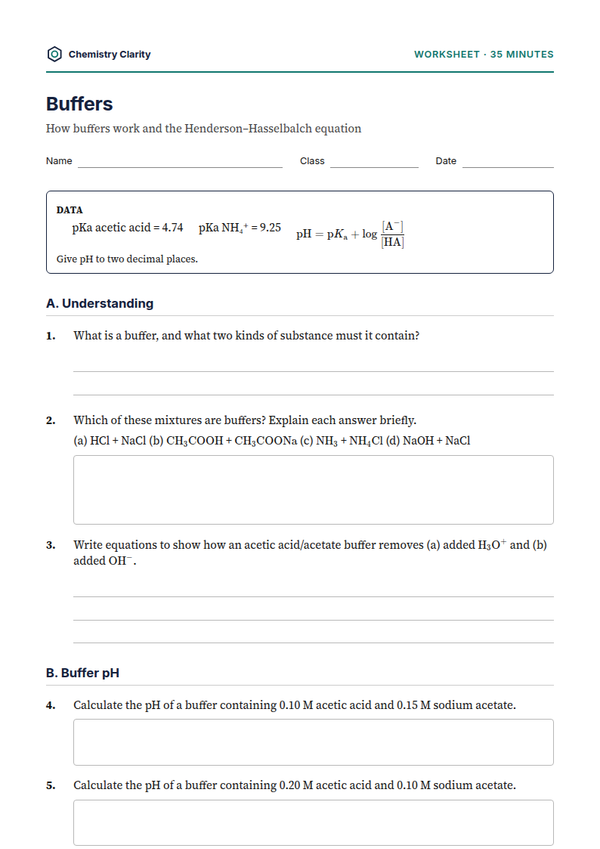
All the questions on this worksheet (about 35 minutes). Download the PDF to print it with space for working; the free answer key has full worked solutions.
A. Understanding
1.
What is a buffer, and what two kinds of substance must it contain?
2.
Which of these mixtures are buffers? Explain each answer briefly.
(a) HCl + NaCl (b) + (c) + (d) NaOH + NaCl
3.
Write equations to show how an acetic acid/acetate buffer removes (a) added and (b) added .
B. Buffer pH
4.
Calculate the pH of a buffer containing 0.10 M acetic acid and 0.15 M sodium acetate.
5.
Calculate the pH of a buffer containing 0.20 M acetic acid and 0.10 M sodium acetate.
6.
Calculate the pH of a buffer containing 0.20 M ammonia and 0.10 M ammonium chloride.
C. Adding acid
7.
0.500 L of buffer contains 0.20 M acetic acid and 0.20 M sodium acetate. Calculate the pH after adding 0.020 mol of HCl.
D. Challenge
8.
What ratio is needed to make an acetate buffer with pH 5.00?