Worksheet
Significant Figures Worksheet
9 questions on counting significant figures, scientific notation, rounding and calculations with measurements. Answer key included.
- Type
- Worksheet
- Level
- Beginner
- Format
- PDF, ready to print
Preview the questions
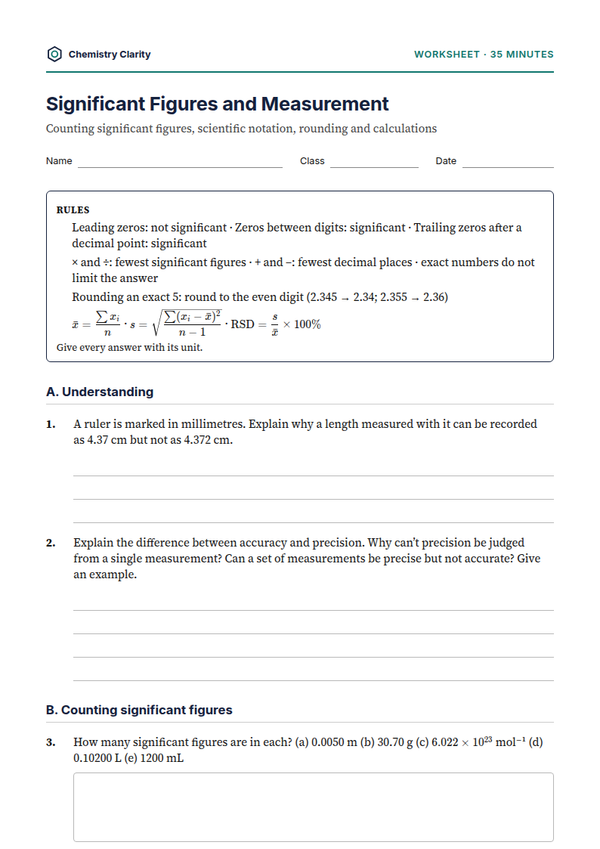
All the questions on this worksheet (about 35 minutes). Download the PDF to print it with space for working; the free answer key has full worked solutions.
A. Understanding
1.
A ruler is marked in millimetres. Explain why a length measured with it can be recorded as 4.37 cm but not as 4.372 cm.
2.
Explain the difference between accuracy and precision. Why can’t precision be judged from a single measurement? Can a set of measurements be precise but not accurate? Give an example.
B. Counting significant figures
3.
How many significant figures are in each? (a) 0.0050 m (b) 30.70 g (c) mol⁻¹ (d) 0.10200 L (e) 1200 mL
C. Scientific notation and rounding
4.
Write in scientific notation, keeping the significant figures: (a) 0.000 350 m (b) 45 600 g (to 3 significant figures) (c) 0.0207 L
5.
Round each to three significant figures: (a) 2.4562 g (b) 0.0012349 m (c) 18 750 s (d) 9.9951 mL (e) 4.365 g (f) 4.375 g
D. Calculations
6.
Calculate and give each answer to the correct number of significant figures: (a) 3.25 cm × 2.1 cm (b) 100.0 g ÷ 3.0 mL (c) 8.315 J/(mol·K) × 298 K
7.
Calculate to the correct precision: (a) 12.0 g + 0.335 g + 4.5 g (b) 6.38 cm − 2.1 cm
E. Challenge
8.
An aluminium block measures 2.00 cm × 3.00 cm × 4.00 cm and has a mass of 64.8 g. Calculate its volume and its density, each to the correct number of significant figures.
9.
A student weighs a certified 2.500 g standard mass in triplicate and records 2.52 g, 2.48 g and 2.51 g. (a) Calculate the mean, the standard deviation and the relative standard deviation. (b) Calculate the error and the percent error. (c) Comment on the accuracy and precision, and report the result as mean ± standard deviation.