Worksheet
Polymers Worksheet
9 questions on monomers, repeat units, addition and condensation polymers, degree of polymerization, composition and disposal. Answer key included.
- Type
- Worksheet
- Level
- Intermediate
- Format
- PDF, ready to print
Preview the questions
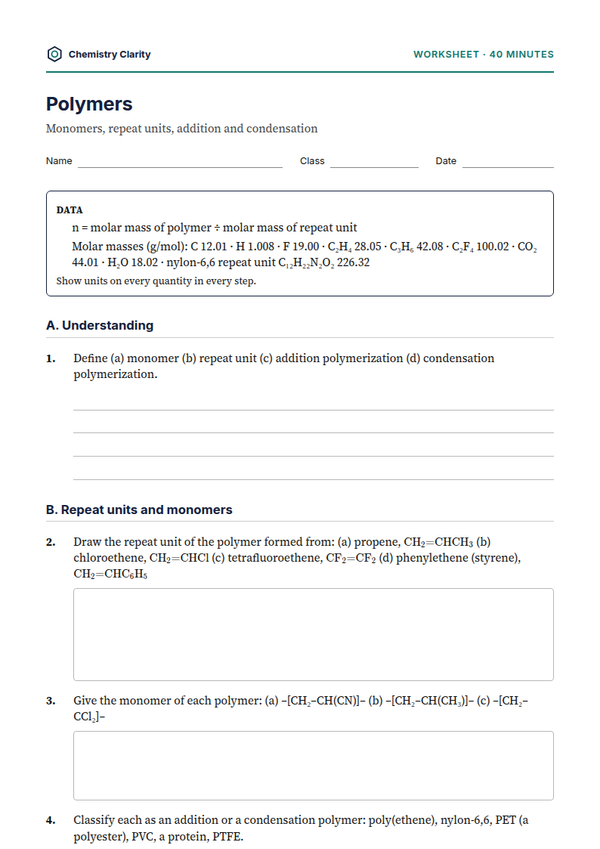
All the questions on this worksheet (about 40 minutes). Download the PDF to print it with space for working; the free answer key has full worked solutions.
A. Understanding
1.
Define (a) monomer (b) repeat unit (c) addition polymerization (d) condensation polymerization.
B. Repeat units and monomers
2.
Draw the repeat unit of the polymer formed from: (a) propene, (b) chloroethene, (c) tetrafluoroethene, (d) phenylethene (styrene),
3.
Give the monomer of each polymer: (a) –[CH₂–CH(CN)]– (b) –[CH₂–CH(CH₃)]– (c) –[CH₂–CCl₂]–
4.
Classify each as an addition or a condensation polymer: poly(ethene), nylon-6,6, PET (a polyester), PVC, a protein, PTFE.
5.
Nylon-6,6 is made from hexanedioic acid, , and hexane-1,6-diamine, . (a) Name the type of link formed and draw it. (b) What small molecule is released?
C. Calculations
6.
(a) A PTFE sample has an average molar mass of 3.00 × 10⁵ g/mol. Find the average number of repeat units. (b) A poly(propene) chain has 3.00 × 10³ repeat units. Find its molar mass.
7.
Calculate the percentage by mass of fluorine in PTFE.
8.
Forming each repeat unit of nylon-6,6 releases 2 molecules of water. What mass of water is released when 1.00 kg of nylon-6,6 is made?
D. Challenge
9.
(a) Write a balanced equation for the complete combustion of poly(ethene), using one repeat unit, . (b) What mass of forms when 1.00 kg of poly(ethene) waste is burned? (c) Give one advantage and two disadvantages of burning plastic waste compared with recycling it.