Worksheet
Periodic Trends Worksheet
9 questions on atomic radius, ionization energy, electronegativity and ionic radius. Answer key included.
- Type
- Worksheet
- Level
- Intermediate
- Format
- PDF, ready to print
Preview the questions
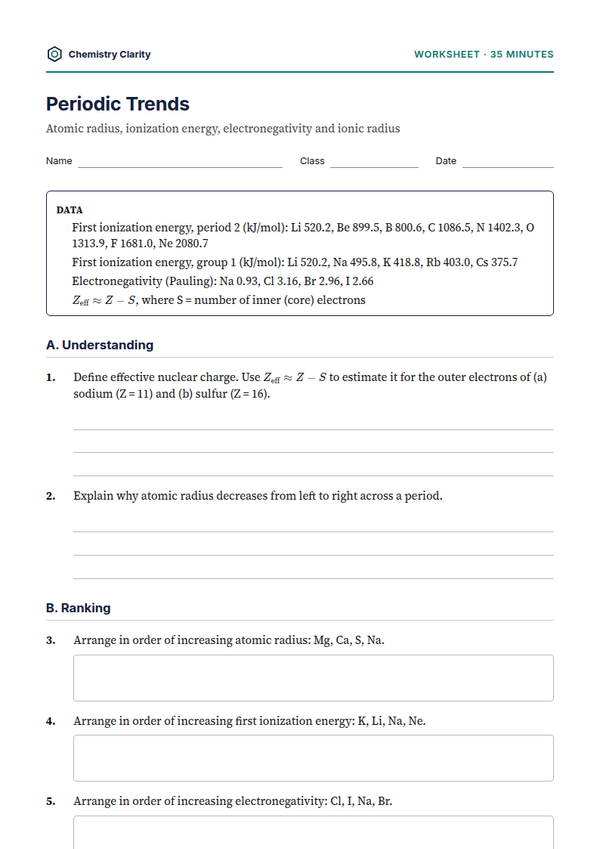
All the questions on this worksheet (about 35 minutes). Download the PDF to print it with space for working; the free answer key has full worked solutions.
A. Understanding
1.
Define effective nuclear charge. Use to estimate it for the outer electrons of (a) sodium (Z = 11) and (b) sulfur (Z = 16).
2.
Explain why atomic radius decreases from left to right across a period.
B. Ranking
3.
Arrange in order of increasing atomic radius: Mg, Ca, S, Na.
4.
Arrange in order of increasing first ionization energy: K, Li, Na, Ne.
5.
Arrange in order of increasing electronegativity: Cl, I, Na, Br.
C. Ionization energy
6.
Describe and explain the trend in first ionization energy down group 1, using the data above.
7.
Across period 2, first ionization energy generally increases, but B is lower than Be and O is lower than N. Explain both exceptions.
D. Ionic radius
8.
(a) Which is larger, Cl or ? (b) Which is larger, Mg or ? Explain each briefly.
E. Challenge
9.
, , and all have 18 electrons. Arrange them in order of decreasing radius and explain your order.