Worksheet
Molecular Shapes (VSEPR) Worksheet
9 questions on electron domains, molecular shapes, bond angles and polarity. Answer key included.
- Type
- Worksheet
- Level
- Intermediate
- Format
- PDF, ready to print
Preview the questions
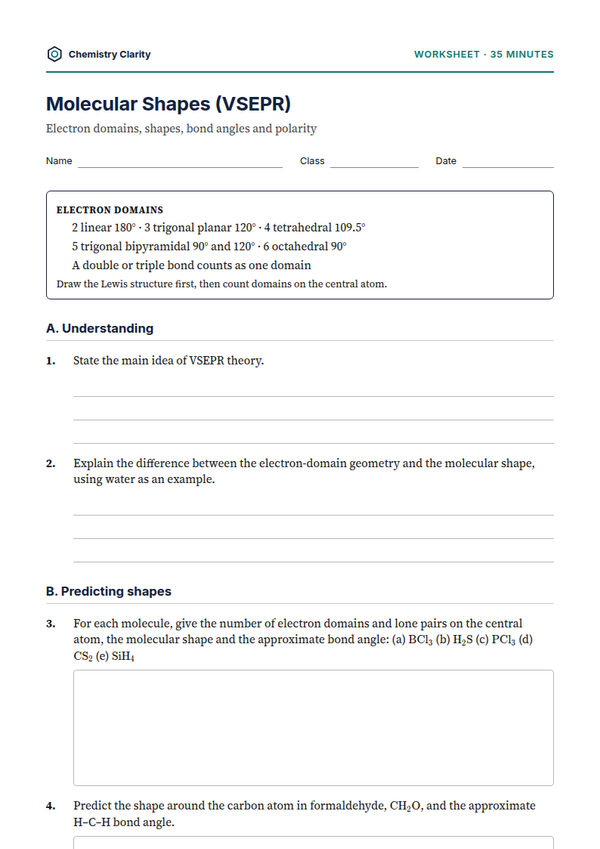
All the questions on this worksheet (about 35 minutes). Download the PDF to print it with space for working; the free answer key has full worked solutions.
A. Understanding
1.
State the main idea of VSEPR theory.
2.
Explain the difference between the electron-domain geometry and the molecular shape, using water as an example.
B. Predicting shapes
3.
For each molecule, give the number of electron domains and lone pairs on the central atom, the molecular shape and the approximate bond angle: (a) (b) (c) (d) (e)
4.
Predict the shape around the carbon atom in formaldehyde, , and the approximate H–C–H bond angle.
5.
Predict the shape of the ammonium ion, .
C. Bond angles
6.
The bond angles in , and are 109.5°, about 107° and about 104.5°. Explain this trend.
D. Polarity
7.
State whether each molecule is polar or nonpolar, with a reason: (a) (b) (c) (d)
E. Challenge
8.
has six electron domains on xenon, two of which are lone pairs. Predict its molecular shape and explain where the lone pairs go.
9.
has five electron domains on sulfur, one of which is a lone pair. Name its shape.