Worksheet
Limiting Reactants Worksheet
8 questions on limiting and excess reactants, theoretical yield and percent yield, in moles and grams. Answer key included.
- Type
- Worksheet
- Level
- Intermediate
- Format
- PDF, ready to print
Preview the questions
All the questions on this worksheet (about 45 minutes). Download the PDF to print it with space for working; the free answer key has full worked solutions.
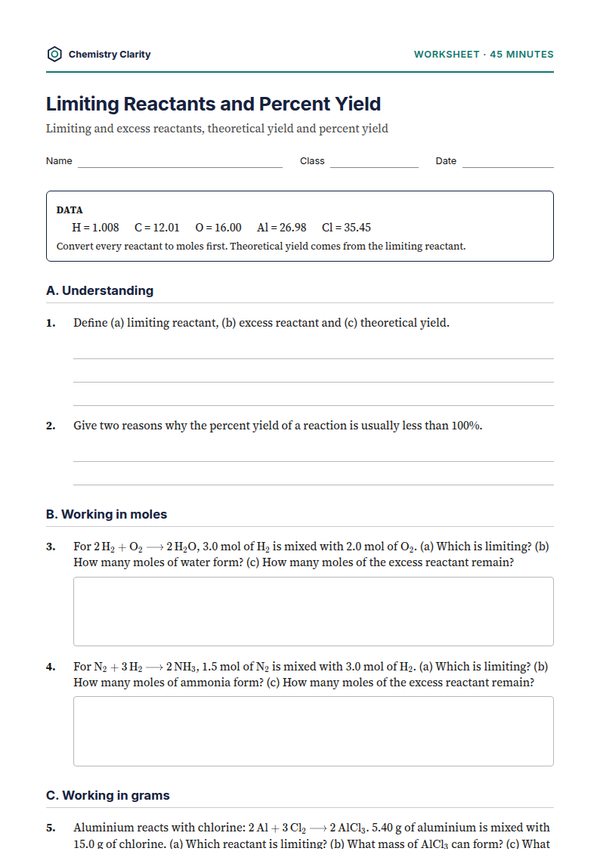
A. Understanding
1.
Define (a) limiting reactant, (b) excess reactant and (c) theoretical yield.
2.
Give two reasons why the percent yield of a reaction is usually less than 100%.
B. Working in moles
3.
For , 3.0 mol of is mixed with 2.0 mol of . (a) Which is limiting? (b) How many moles of water form? (c) How many moles of the excess reactant remain?
4.
For , 1.5 mol of is mixed with 3.0 mol of . (a) Which is limiting? (b) How many moles of ammonia form? (c) How many moles of the excess reactant remain?
C. Working in grams
5.
Aluminium reacts with chlorine: . 5.40 g of aluminium is mixed with 15.0 g of chlorine. (a) Which reactant is limiting? (b) What mass of can form? (c) What mass of the excess reactant is left over?
6.
In the experiment in question 5, 15.2 g of is actually collected. Calculate the percent yield.
7.
Methane burns: . 10.0 g of methane is mixed with 32.0 g of oxygen. (a) Which is limiting? (b) What mass of forms? (c) What mass of the excess reactant is left over?
D. Challenge
8.
A student reports a percent yield of 108%. Suggest a likely reason, and explain why a yield above 100% is impossible for a pure, dry product.