Worksheet
Galvanic Cells and Electrode Potentials Worksheet
9 questions on galvanic cells, standard reduction potentials, E°cell, cell notation, ΔG° and electrolysis calculations. Answer key included.
- Type
- Worksheet
- Level
- Intermediate
- Format
- PDF, ready to print
Preview the questions
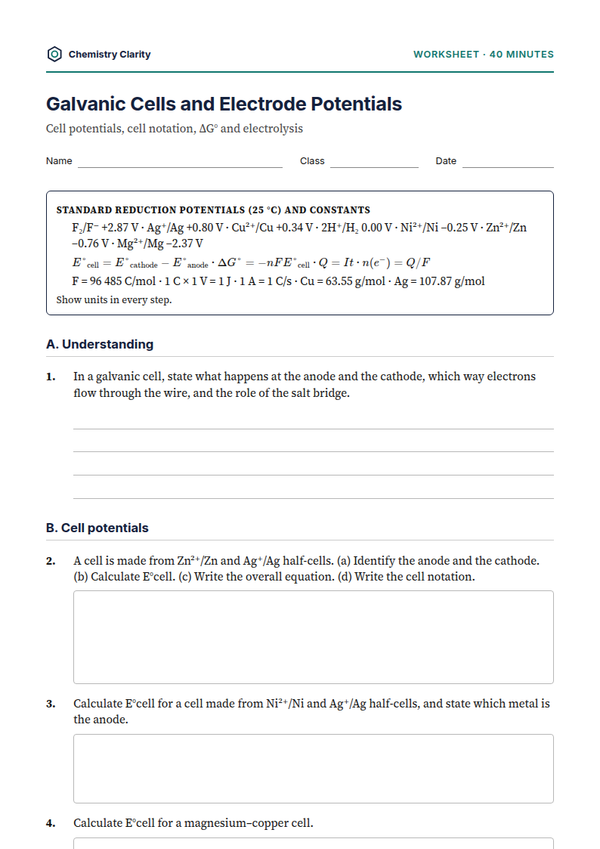
All the questions on this worksheet (about 40 minutes). Download the PDF to print it with space for working; the free answer key has full worked solutions.
A. Understanding
1.
In a galvanic cell, state what happens at the anode and the cathode, which way electrons flow through the wire, and the role of the salt bridge.
B. Cell potentials
2.
A cell is made from Zn²⁺/Zn and Ag⁺/Ag half-cells. (a) Identify the anode and the cathode. (b) Calculate E°cell. (c) Write the overall equation. (d) Write the cell notation.
3.
Calculate E°cell for a cell made from Ni²⁺/Ni and Ag⁺/Ag half-cells, and state which metal is the anode.
4.
Calculate E°cell for a magnesium–copper cell.
5.
Use E°cell to decide whether each reaction is spontaneous: (a) (b)
6.
From the data, identify the strongest oxidizing agent and the strongest reducing agent.
C. Free energy
7.
Calculate ΔG° for the Daniell cell, .
D. Electrolysis
8.
A spoon is silver-plated using a current of 1.50 A for 45.0 min (). What mass of silver is deposited?
E. Challenge
9.
How long, in minutes, must a current of 3.00 A flow through copper(II) sulfate solution to deposit 5.00 g of copper ()?