Worksheet
Nuclear Medicine and Radiation Safety Worksheet
9 questions on radiation units, choosing isotopes, dose calculations, the inverse-square law, shielding and PET. Answer key included.
- Type
- Worksheet
- Level
- Intermediate
- Format
- PDF, ready to print
Preview the questions
All the questions on this worksheet (about 40 minutes). Download the PDF to print it with space for working; the free answer key has full worked solutions.
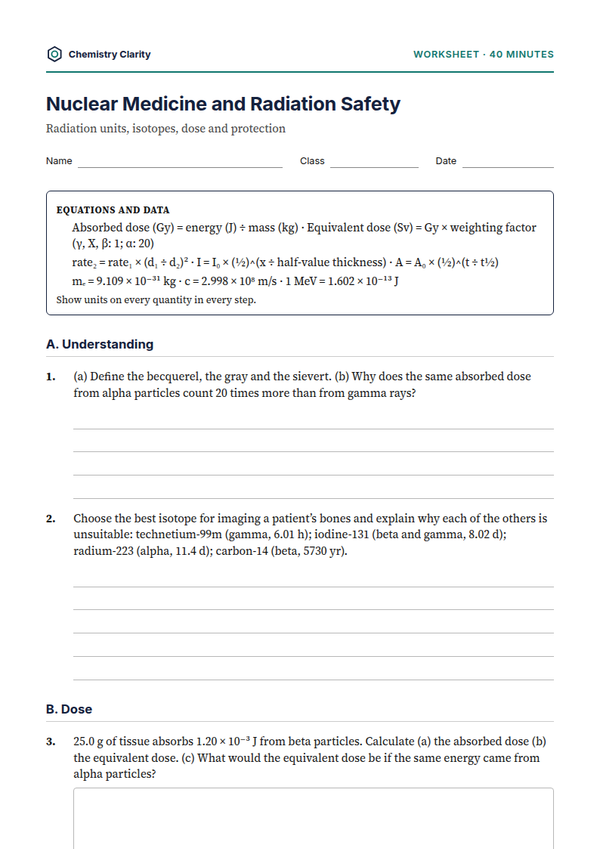
A. Understanding
1.
(a) Define the becquerel, the gray and the sievert. (b) Why does the same absorbed dose from alpha particles count 20 times more than from gamma rays?
2.
Choose the best isotope for imaging a patient’s bones and explain why each of the others is unsuitable: technetium-99m (gamma, 6.01 h); iodine-131 (beta and gamma, 8.02 d); radium-223 (alpha, 11.4 d); carbon-14 (beta, 5730 yr).
B. Dose
3.
25.0 g of tissue absorbs 1.20 × 10⁻³ J from beta particles. Calculate (a) the absorbed dose (b) the equivalent dose. (c) What would the equivalent dose be if the same energy came from alpha particles?
C. Protection
4.
The dose rate 1.00 m from a source is 40.0 µSv/h. (a) What is it at 0.500 m? (b) At what distance would it be 1.00 µSv/h?
5.
A technician works for 15.0 min where the dose rate is 10.0 µSv/h. What dose do they receive?
6.
A lead apron reduces gamma rays with a half-value thickness of 0.30 mm (a teaching value). (a) What percentage passes through 1.20 mm? (b) What thickness lets through 1/32?
D. Isotopes in use
7.
370 MBq of fluorine-18 ( = 110 min) is prepared at 07:00. What is its activity at 09:00?
8.
Show that the energy of each gamma ray in a PET scan, 511 keV, equals the rest-mass energy of an electron.
E. Challenge
9.
Suppose a scan gives an effective dose of 7.0 mSv. (a) How many years of average natural background (2.4 mSv per year) is this? (b) Explain why such a scan may still be the right choice for a patient.