Worksheet
IR Spectroscopy and Mass Spectrometry Worksheet
8 questions on IR absorptions and functional groups, wavenumbers, molecular ions, fragments, isotope patterns and identifying an unknown. Answer key included.
- Type
- Worksheet
- Level
- Intermediate
- Format
- PDF, ready to print
Preview the questions
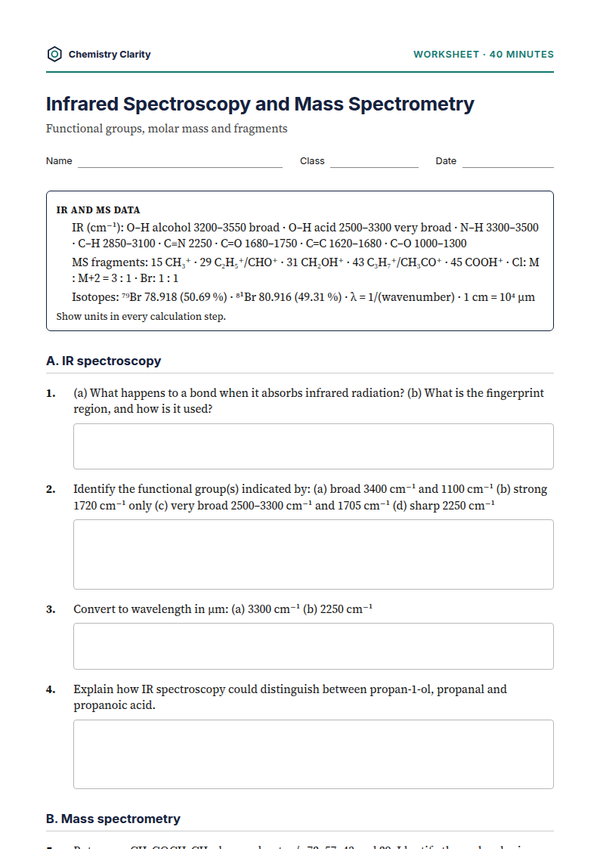
All the questions on this worksheet (about 40 minutes). Download the PDF to print it with space for working; the free answer key has full worked solutions.
A. IR spectroscopy
1.
(a) What happens to a bond when it absorbs infrared radiation? (b) What is the fingerprint region, and how is it used?
2.
Identify the functional group(s) indicated by: (a) broad 3400 cm⁻¹ and 1100 cm⁻¹ (b) strong 1720 cm⁻¹ only (c) very broad 2500–3300 cm⁻¹ and 1705 cm⁻¹ (d) sharp 2250 cm⁻¹
3.
Convert to wavelength in μm: (a) 3300 cm⁻¹ (b) 2250 cm⁻¹
4.
Explain how IR spectroscopy could distinguish between propan-1-ol, propanal and propanoic acid.
B. Mass spectrometry
5.
Butanone, , has peaks at m/z 72, 57, 43 and 29. Identify the molecular ion and the ion responsible for each fragment.
6.
A compound shows peaks at m/z 78 and 80 in a 3 : 1 ratio; another shows peaks at 122 and 124 in a 1 : 1 ratio. What halogen does each contain?
7.
Use the isotope data to calculate the relative atomic mass of bromine.
C. Challenge
8.
An unknown has IR absorptions at 2500–3300 cm⁻¹ (very broad) and 1710 cm⁻¹. Its mass spectrum has peaks at m/z 60, 45, 43 and 15. Identify the compound and explain each piece of evidence.