Worksheet
Empirical and Molecular Formulas Worksheet
9 questions: simplest ratios, empirical formulas from percent composition, and molecular formulas from molar mass. Answer key included.
- Type
- Worksheet
- Level
- Intermediate
- Format
- PDF, ready to print
Preview the questions
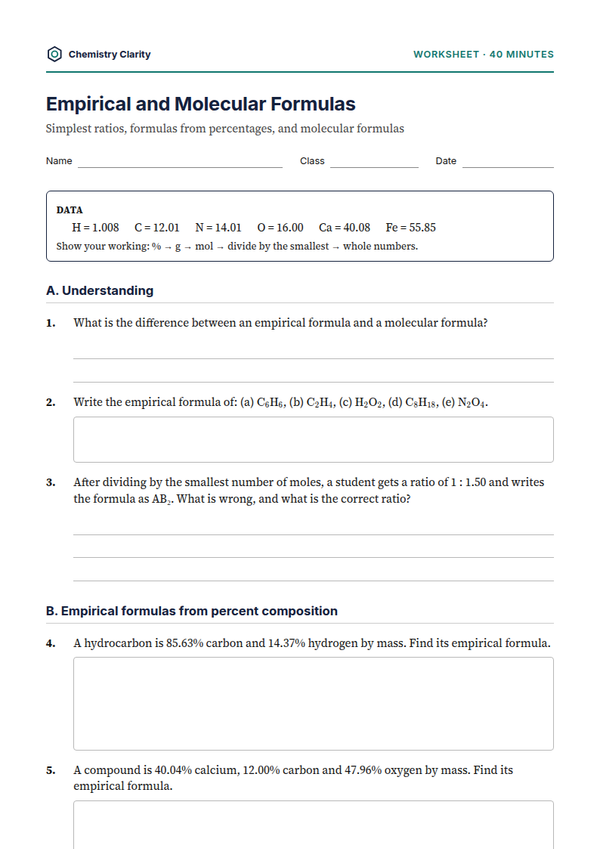
All the questions on this worksheet (about 40 minutes). Download the PDF to print it with space for working; the free answer key has full worked solutions.
A. Understanding
1.
What is the difference between an empirical formula and a molecular formula?
2.
Write the empirical formula of: (a) , (b) , (c) , (d) , (e) .
3.
After dividing by the smallest number of moles, a student gets a ratio of 1 : 1.50 and writes the formula as AB₂. What is wrong, and what is the correct ratio?
B. Empirical formulas from percent composition
4.
A hydrocarbon is 85.63% carbon and 14.37% hydrogen by mass. Find its empirical formula.
5.
A compound is 40.04% calcium, 12.00% carbon and 47.96% oxygen by mass. Find its empirical formula.
6.
An oxide of iron is 72.36% iron and 27.64% oxygen by mass. Find its empirical formula.
C. Molecular formulas
7.
A compound has empirical formula and molar mass 60.05 g/mol. Find its molecular formula.
8.
Acetylene has empirical formula and molar mass 26.04 g/mol. Find its molecular formula.
D. Challenge
9.
A compound of nitrogen and oxygen is 30.43% nitrogen by mass, and its molar mass is 92.02 g/mol. Find its empirical and molecular formulas.