Worksheet
Spectrophotometry and Beer's Law Worksheet
9 questions on transmittance and absorbance, Beer's law, dilution, calibration curves with replicates, and a copper analysis. Answer key included.
- Type
- Worksheet
- Level
- Intermediate
- Format
- PDF, ready to print
Preview the questions
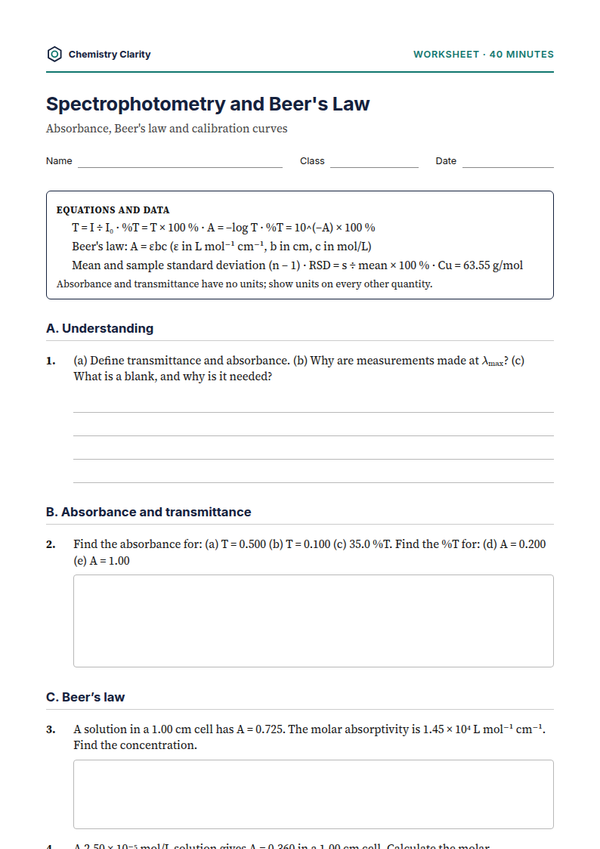
All the questions on this worksheet (about 40 minutes). Download the PDF to print it with space for working; the free answer key has full worked solutions.
A. Understanding
1.
(a) Define transmittance and absorbance. (b) Why are measurements made at ? (c) What is a blank, and why is it needed?
B. Absorbance and transmittance
2.
Find the absorbance for: (a) T = 0.500 (b) T = 0.100 (c) 35.0 %T. Find the %T for: (d) A = 0.200 (e) A = 1.00
C. Beer’s law
3.
A solution in a 1.00 cm cell has A = 0.725. The molar absorptivity is 1.45 × 10⁴ L mol⁻¹ cm⁻¹. Find the concentration.
4.
A 2.50 × 10⁻⁵ mol/L solution gives A = 0.360 in a 1.00 cm cell. Calculate the molar absorptivity, with its units.
5.
For the solution in question 4, predict the absorbance (a) in a 2.00 cm cell (b) at half the concentration in a 1.00 cm cell. Explain using Beer’s law.
6.
An unknown gives A = 1.85, which is above the calibration range. 10.00 mL of it is diluted to 50.00 mL, and the diluted solution gives A = 0.370 in a 1.00 cm cell ( = 1.20 × 10⁴ L mol⁻¹ cm⁻¹). Find the concentration of (a) the diluted solution (b) the original unknown.
D. Calibration and replicates
7.
A set of standards gives the best-fit line . An unknown is measured in triplicate: A = 0.334, 0.338, 0.331. (a) Find the mean absorbance, the standard deviation and the RSD. (b) Find the concentration of the unknown.
8.
Explain (a) why the unknown in question 7 is measured three times instead of once (b) why the unknown should lie inside the range of the standards (c) what a large intercept on the calibration line might show.
E. Challenge
9.
0.1000 g of brass is dissolved in acid, the copper is converted into a coloured complex, and the solution is diluted to exactly 1.000 L. It gives A = 0.409 in a 1.00 cm cell, and of the complex is 395.0 L mol⁻¹ cm⁻¹. Calculate the percentage by mass of copper in the brass.