Learning objectives
By the end of these notes you should be able to:
- Explain what a mole is and why chemists use it.
- State the value of the Avogadro constant and how the mole is defined.
- Calculate the molar mass of an element or compound from its formula.
- Convert between mass, amount (moles) and number of particles.
- Work out the number of moles of atoms of each element in a given amount of a compound.
1. Why chemists need a counting unit
Chemical reactions happen between individual atoms, molecules and ions. A balanced equation therefore tells us how many particles react. Particles are far too small to count directly, so we need a way to count them by weighing.
Everyday life already uses counting units for large numbers of small things: a dozen eggs (12), a ream of paper (500 sheets). Chemistry uses the mole, a much larger number suited to atoms.
2. The mole and the Avogadro constant
- One mole (symbol mol) of a substance contains 6.022 × 10²³ specified particles.
- The particles must always be stated: atoms of Na, molecules of , formula units of , ions of .
- The Avogadro constant is .
- The quantity measured in moles is called amount of substance, symbol .
More precisely: The SI definition
Since 2019 the mole has been defined by fixing the Avogadro constant at exactly 6.022 140 76 × 10²³ mol⁻¹. The older definition, the number of atoms in exactly 12 g of carbon-12, still appears in many textbooks. The two agree to far more digits than any calculation in these notes needs.
3. Molar mass
The molar mass of a substance is the mass of one mole of it, in g/mol.
Key fact: the molar mass in g/mol has the same numerical value as the atomic mass or formula mass in atomic mass units (u).
3.1 Elements
Read the atomic mass from the periodic table: g/mol, g/mol.
For elements that exist as molecules, use the molecular formula: g/mol and g/mol.
3.2 Compounds
Add the atomic masses of every atom in the formula, multiplying by the subscripts:
| Formula | Calculation | Molar mass |
|---|---|---|
| 2(1.008) + 16.00 | 18.02 g/mol | |
| 14.01 + 3(1.008) | 17.03 g/mol | |
| 40.08 + 12.01 + 3(16.00) | 100.09 g/mol | |
| 6(12.01) + 12(1.008) + 6(16.00) | 180.16 g/mol |
For ionic compounds such as there are no molecules, so we speak of the mass of a formula unit. The calculation is the same: 22.99 + 35.45 = 58.44 g/mol.
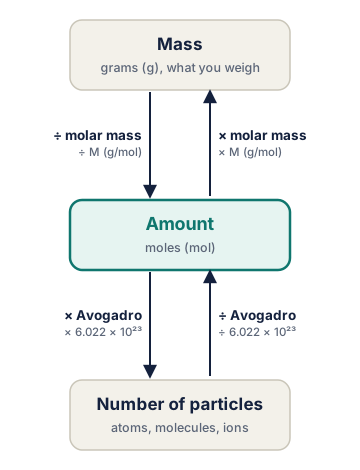
4. The three-way conversion
Every conversion passes through moles:
Problem-solving routine
- Write down what you are given, with units.
- Find any molar mass you need.
- Convert to moles first.
- Convert from moles to what is asked.
- Check that the units cancel and the answer is sensible.
4.1 Mass → moles
Worked example: Moles of ammonia
How many moles are in 51.1 g of ammonia, ?
- g/mol
4.2 Moles → mass
Worked example: Mass of calcium carbonate
What is the mass of 2.50 mol of calcium carbonate, ?
- g/mol
- (that is, 2.50 × 10² g)
4.3 Mass → particles
Worked example: Molecules of glucose
How many molecules are in 4.50 g of glucose, ?
- g/mol
- molecules
5. Moles of atoms inside a compound
The subscripts in a formula give the ratio of moles of atoms to moles of compound.
One mole of glucose, , contains 6 mol of C atoms, 12 mol of H atoms and 6 mol of O atoms.
Worked example: Atoms of hydrogen in water
How many hydrogen atoms are in 0.250 mol of water?
- Each contains 2 H atoms, so mol
- atoms
Common mistake
Always ask “a mole of what?”. One mole of is 6.022 × 10²³ molecules but 1.204 × 10²⁴ atoms. Write the formula, then count.
6. Significant figures
- Atomic masses from the periodic table usually carry four or more significant figures, so they rarely limit your answer.
- Your answer should normally have the same number of significant figures as the least precise measured value given (often a mass).
- Keep extra digits in intermediate steps and round only at the end.
Summary
Remember this
- 1 mol = 6.022 × 10²³ particles; always state the particles.
- Molar mass (g/mol) has the same number as the atomic or formula mass (u).
- and ; convert to moles first.
- Formula subscripts give moles of each kind of atom per mole of compound.
Key terms
| Term | Meaning |
|---|---|
| Mole (mol) | The SI unit of amount of substance; 6.022 × 10²³ specified particles |
| Amount of substance, | The quantity measured in moles |
| Avogadro constant, | 6.022 × 10²³ mol⁻¹ |
| Molar mass, | Mass of one mole of a substance, in g/mol |
| Formula unit | The smallest repeating unit of an ionic compound, e.g. one Na⁺ and one Cl⁻ in NaCl |