Worksheet
Integrated Rate Laws and Mechanisms Worksheet
9 questions on zero-, first- and second-order calculations, half-lives, finding the order from data and reaction mechanisms. Answer key included.
- Type
- Worksheet
- Level
- Advanced
- Format
- PDF, ready to print
Preview the questions
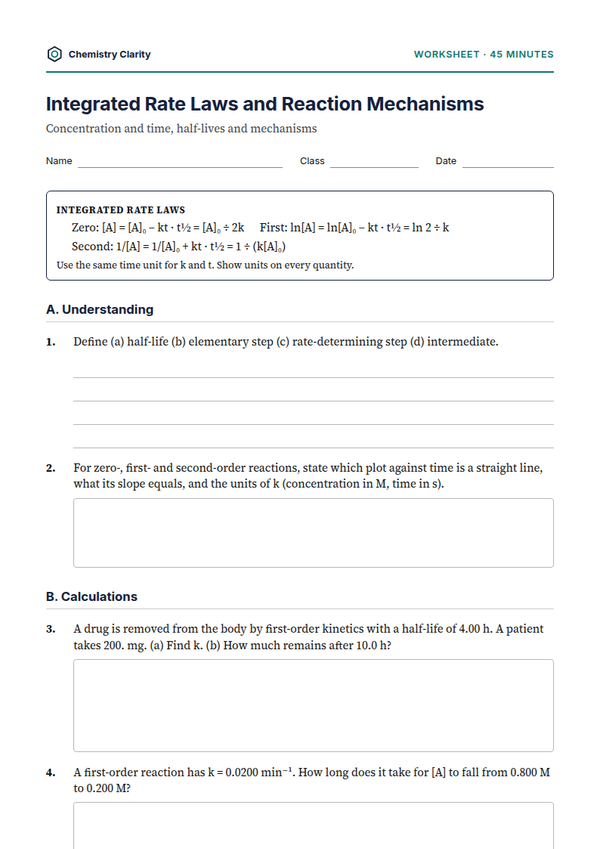
All the questions on this worksheet (about 45 minutes). Download the PDF to print it with space for working; the free answer key has full worked solutions.
A. Understanding
1.
Define (a) half-life (b) elementary step (c) rate-determining step (d) intermediate.
2.
For zero-, first- and second-order reactions, state which plot against time is a straight line, what its slope equals, and the units of k (concentration in M, time in s).
B. Calculations
3.
A drug is removed from the body by first-order kinetics with a half-life of 4.00 h. A patient takes 200. mg. (a) Find k. (b) How much remains after 10.0 h?
4.
A first-order reaction has k = 0.0200 min⁻¹. How long does it take for [A] to fall from 0.800 M to 0.200 M?
5.
A second-order reaction has k = 0.150 M⁻¹ s⁻¹ and [A]₀ = 0.0500 M. Find (a) the first half-life (b) [A] after 200. s.
6.
A zero-order decomposition on a metal surface has k = 2.50 × 10⁻³ M/s and [A]₀ = 0.500 M. Find (a) the half-life (b) the time for all of A to be used up.
C. Order from data
7.
For a reaction A → products: [A] = 0.400, 0.300, 0.225 and 0.169 M at t = 0, 100, 200 and 300 s. Show that the reaction is first order and find k.
D. Mechanisms
8.
A proposed mechanism is: step 1 (slow); step 2 (fast). (a) Write the overall equation. (b) Identify the intermediate. (c) Write the rate law predicted by this mechanism.
E. Challenge
9.
A second-order reaction has k = 0.0500 M⁻¹ s⁻¹ and [A]₀ = 0.100 M. Calculate the first half-life (0.100 M → 0.0500 M) and the second half-life (0.0500 M → 0.0250 M). How could this pattern be used to identify a second-order reaction?